



The California Department of Food and Agriculture (CDFA) Center for Analytical Chemistry (CAC) is assembling a CoResponse team to handle urgent analytical testing requests that may arise due to emergencies, including wildfires.
CoResponse’s first task is setting up instruments and validating the smoke-taint method in preparation for the possibility that assistance is requested by the wine grape industry and commercial labs to test grapes for the presence of smoke from wildfires, as was requested of the CAC last year. In 2020, the CAC analyzed 148 wine grape samples for the presence of seven smoke-taint compounds between October 1 and December 1.
The CAC’s CoResponse team is composed of scientists with diverse backgrounds and expertise representing all CAC programs. They will work on multiple instrument platforms to be able to respond to any analytical emergencies that might arise.
CDFA’s Center for Analytical Chemistry is a branch of the Inspection Services Division.
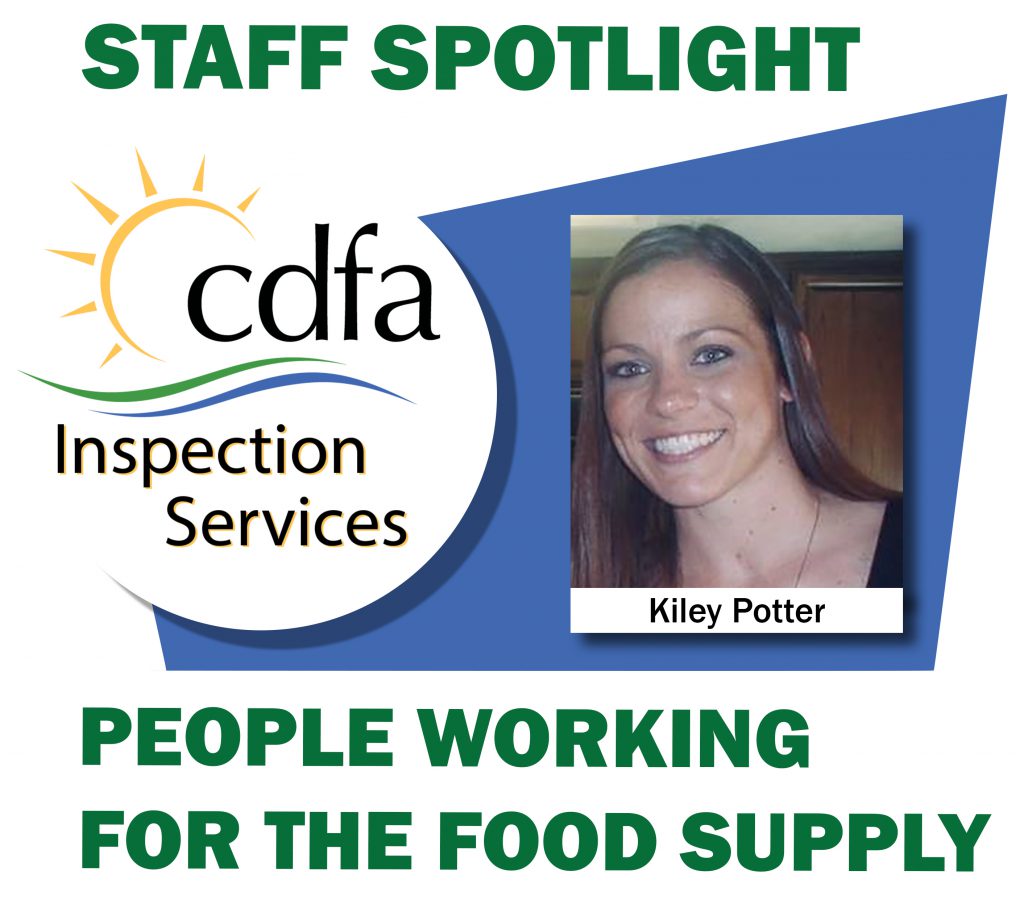
NAME: Kiley Potter
YEARS AT CDFA: 15
PROGRAM: Inspection & Compliance Branch Support Team
TITLE: Associate Governmental Program Analyst (AGPA) – Branch Contract Analyst
USUAL DAILY ACTIVITIES: In tandem with raising kids and a small farm, I spend my days working with counties regarding the agreements they have with CDFA. I currently oversee about 130 agreements. The work includes processing invoices to reimburse counties that performed work on behalf of CDFA. I also process invoices for all programs within my branch for their equipment and supplies.
HOW DO YOU WORK FOR THE CALIFORNIA FOOD SUPPLY? I provide administrative support to the employees responsible for enforcing all regulations and policies to ensure consumers receive products that meet all minimum maturity and quality standards.
MEMORABLE MOMENT ON THE JOB: Honestly had to be my second day working at CDFA when I was given the task to answer our branch’s main phone line. Things got a bit hectic while transferring a call to my branch chief and let’s just say I learned quickly the proper way to transfer a call without hanging up on the caller.
PHILOSOPHY OF LIFE: “You are what you do, not what you say you’ll do.” – Carl Jung
The U.S. Department of Agriculture (USDA) National Institute for Food and Agriculture has awarded the California Department of Food and Agriculture (CDFA) a Gus Schumacher Nutrition Incentive Program COVID Relief and Response (GusCRR) grant of $6,325,464 to support low-income shoppers through the California Nutrition Incentive Program (CNIP). Click here to view USDA’s news release.
“CDFA is grateful to receive a COVID Relief and Response grant,” said CDFA Secretary Karen Ross. “It will go a long way toward helping our families afford healthy food and supporting California farmers.”
CDFA’s CNIP provides nutrition incentives to CalFresh (formerly known as food stamps) shoppers at participating farmers’ markets and retail sites, allowing shoppers to purchase more California-grown fruits and vegetables. For every CalFresh dollar spent, CNIP provides an additional dollar to spend on California-grown fresh fruits and vegetables.
CNIP is administered by CDFA’s Office of Farm to Fork, which leads CDFA’s food access work. More information on the California Nutrition Incentive Program, grantees and participating retail outlets can be found at https://cafarmtofork.cdfa.ca.gov/cnip.html.
Click here to read a CDFA news release with further details about how the GusCRR grant will keep CNIP solvent while meeting increased demand.
Click here to view the August 2021 California Farm to School Network newsletter.
The California Farm to School Network includes farm to school practitioners and enthusiasts statewide. Click on the newsletter subscribe button to also receive these monthly updates that include information about grants, resources, research, webinars, events and news from the National Farm to School Network. The California Farm to School Program is part of the California Department of Food and Agriculture Office of Farm to Fork (CDFA-F2F) in the Division of Inspection Services.
Video in Spanish:
Visit this link for a list of Certified Farmers’ Markets in California.
Joint release by California Department of Food and Agriculture and California Department of Pesticide Regulation
The state is warning organic farmers against the use of pesticides labeled as W.O.W Whack Out Weeds! and EcoMight-Pro distributed by EcoMIGHT, as lab tests show that these products labeled as organic, natural and glyphosate-free do in fact contain potentially hazardous chemicals.
Today, the California Department of Pesticide Regulation (DPR) issued a notice to EcoMIGHT, LLC, a Florida-based company, that it may be in violation of state law by manufacturing, delivering or selling unregistered pesticide products in California. The California Department of Food and Agriculture (CDFA) issued a Stop Use Notice for organic growers about EcoMIGHT products. The United States Environmental Protection Agency (U.S. EPA) also notified EcoMIGHT that it may be in violation of federal law.
EcoMIGHT currently markets its products as “organic,” “natural,” “glyphosate-free,” and “non-toxic and safe.” However, state laboratory analyses of W.O.W. Whack Out Weeds! and EcoMight-Pro products sold in California found that the products tested contain potentially hazardous chemicals including glyphosate, bifenthrin, permethrin, cypermethrin, and carbaryl. California registered pesticides that contain these chemicals go through scientific review and have specific requirements for use and personal protective equipment that protect workers, communities and the environment from harmful pesticide exposure. W.O.W Whack Out Weeds! and EcoMight-Pro do not contain these safety instructions.
The synthetic chemical compounds CDFA laboratory analysis found in W.O.W. Whack Out Weeds! and EcoMight-Pro products are prohibited for use in organic production by the U.S. Department of Agriculture’s National Organic Program. Additionally, these products pose a public health risk because the products were found to contain hazardous chemicals not disclosed on their labels.
“It is imperative that we alert California organic growers that these EcoMIGHT products contain substances that are prohibited in organic production, in order to preserve the integrity of the California organic label and to protect our growers,” said CDFA Secretary Karen Ross.
Read CDFA’s Stop Use Notice.
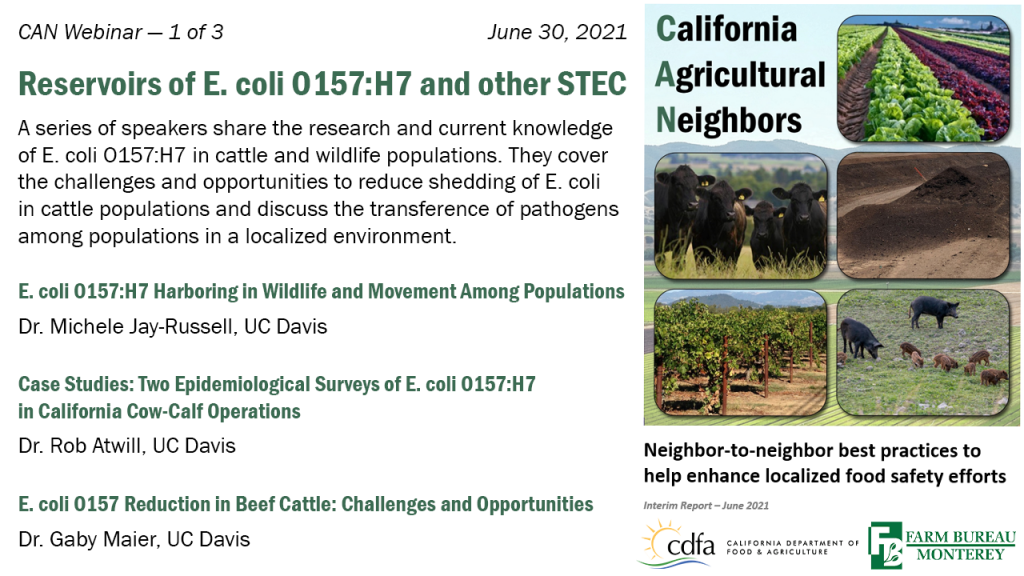
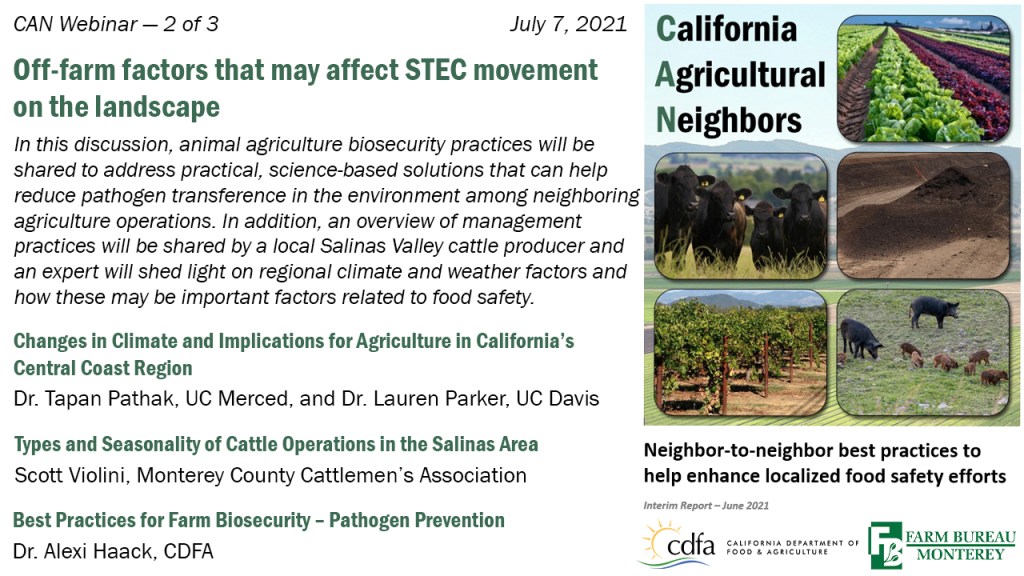
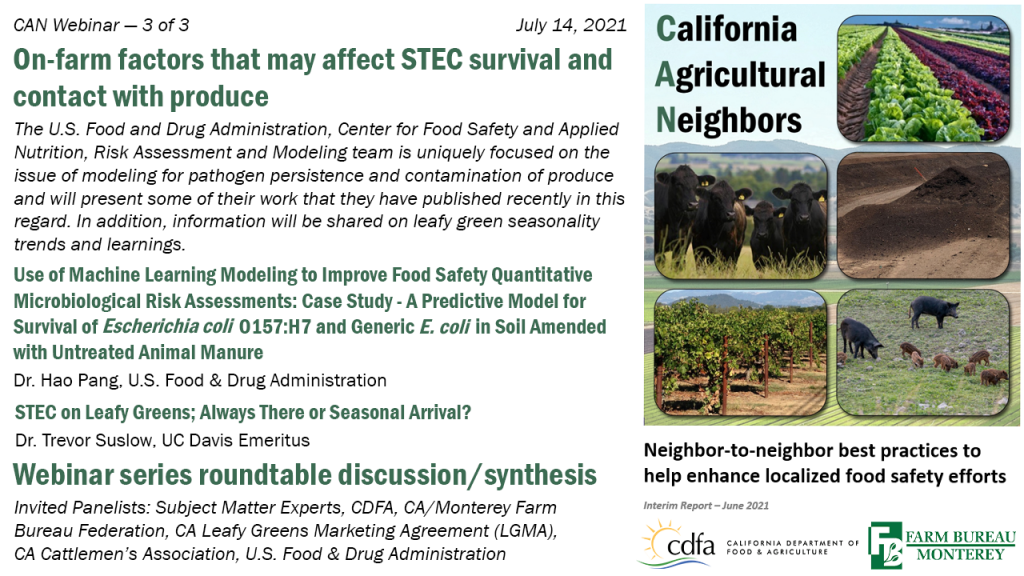
A webinar series hosted by the California Farm Bureau Federation in partnership with the Monterey County Farm Bureau and the California Department of Food and Agriculture (CDFA) about best food safety practices for agricultural neighbors is now available online. The recordings include members of the California Agricultural Neighbors (CAN) group discussing the CAN interim report, “California Agricultural Neighbors: Neighbor-to-neighbor best practices to enhance localized food safety efforts.”
“The diversity of our agricultural community here in California means we can gather an impressive array of subject-matter experts along with farmers and ranchers, and they can get right down to the business of developing cutting-edge food safety practices,” said CDFA Secretary Karen Ross.
“The California Agricultural Neighbors webinars are great examples of the knowledge and collective power of the farming and ranching community when we work together to solve field-level problems,” said Jim Houston, administrator of California Farm Bureau Federation.
CAN membership includes representation from the agricultural production community (leafy greens, cattle ranching, viticulture, compost), academia, associations (industry, consumer/retail) and government (local, state, federal). CAN was formed in response to continued outbreaks of pathogenic E. coli O157:H7 associated with leafy greens in California’s Salinas Valley. CAN provides a roundtable forum to foster collaboration and discuss enhanced neighborly food safety practices when agriculture operations are adjacent to one another.
Click on the images (above) or on the following links to view the webinar recordings:
Click here to view the July 2021 California Farm to School Network newsletter.
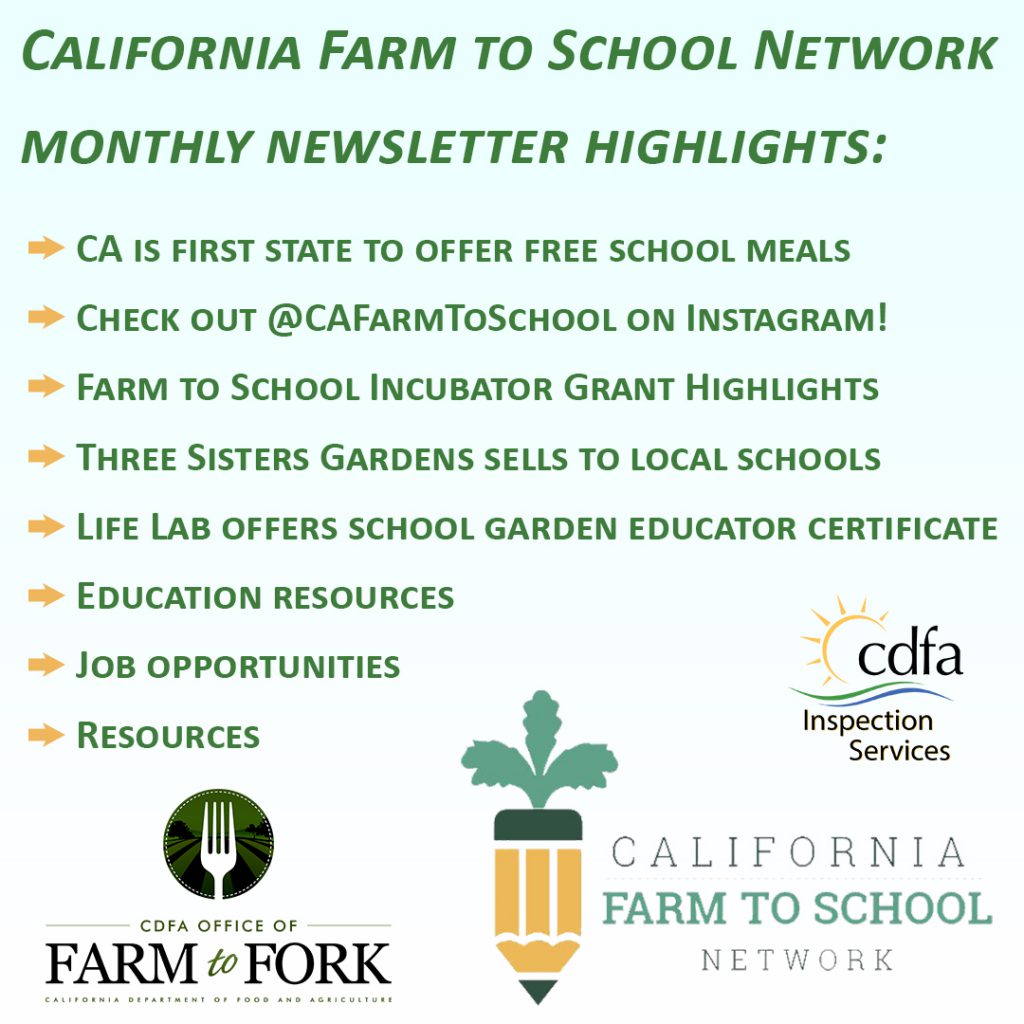
The California Farm to School Network includes farm to school practitioners and enthusiasts statewide. Click on the newsletter subscribe button to also receive these monthly updates that include information about grants, resources, research, webinars, events and news from the National Farm to School Network. The California Farm to School Program is part of the California Department of Food and Agriculture Office of Farm to Fork (CDFA-F2F) in the Division of Inspection Services.
The California Department of Food and Agriculture (CDFA) is announcing vacancies on the Standardization Advisory Committee.
The committee advises the CDFA secretary on all matters pertaining to the Standardization Program, as well as reviewing proposed regulations and making recommendations concerning assessment rates, fees to provide adequate inspection services and the annual budget.
The current vacancies include Fresh Fruit Members representing oranges, other citrus fruit and/or table grapes; Fresh Vegetable Members representing broccoli, lettuce or tomatoes; Other Fresh Vegetable Members representing any fresh vegetable commodity subject to standardization; Other Fresh Fruit Member representing cantaloupe and melon; and Other Commodity Member representing a commodity subject to the Standardization Program.
Click here to read a CDFA press release for more details and directions on how to apply.