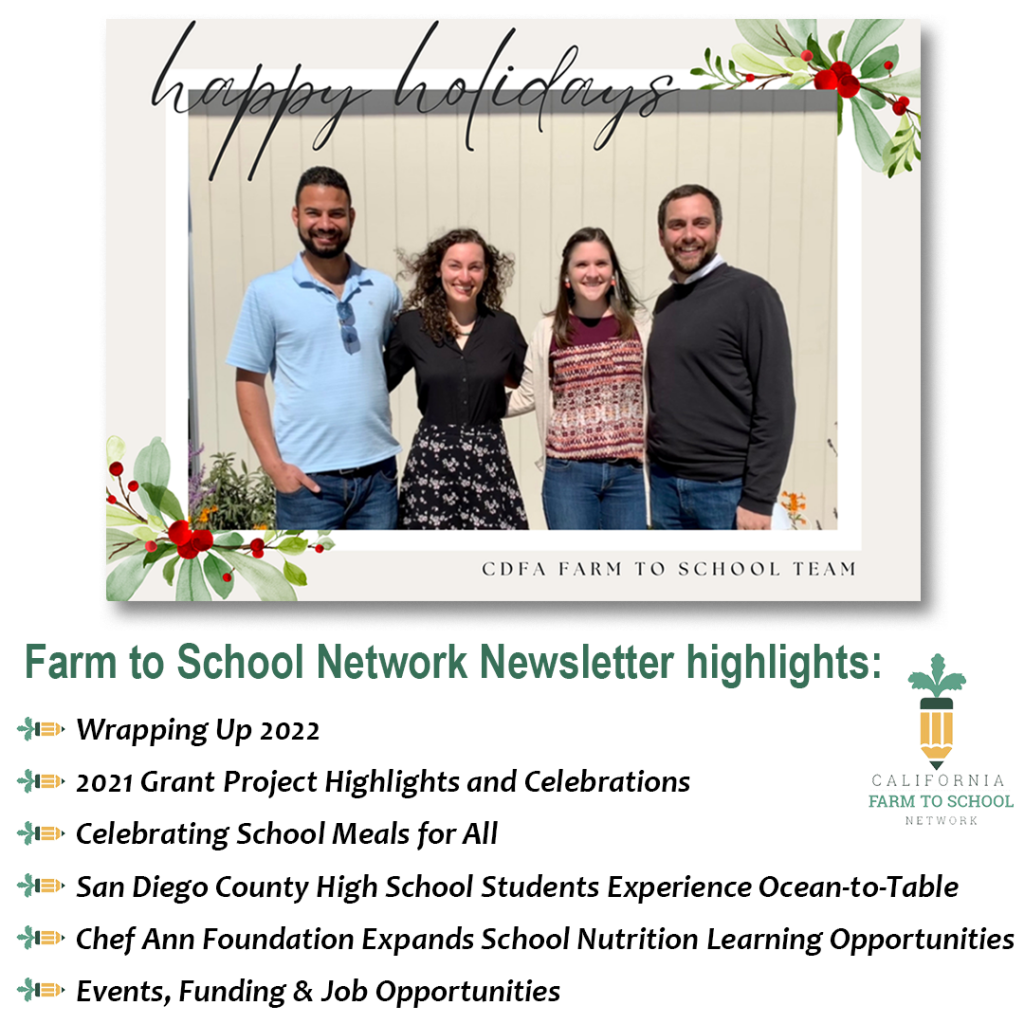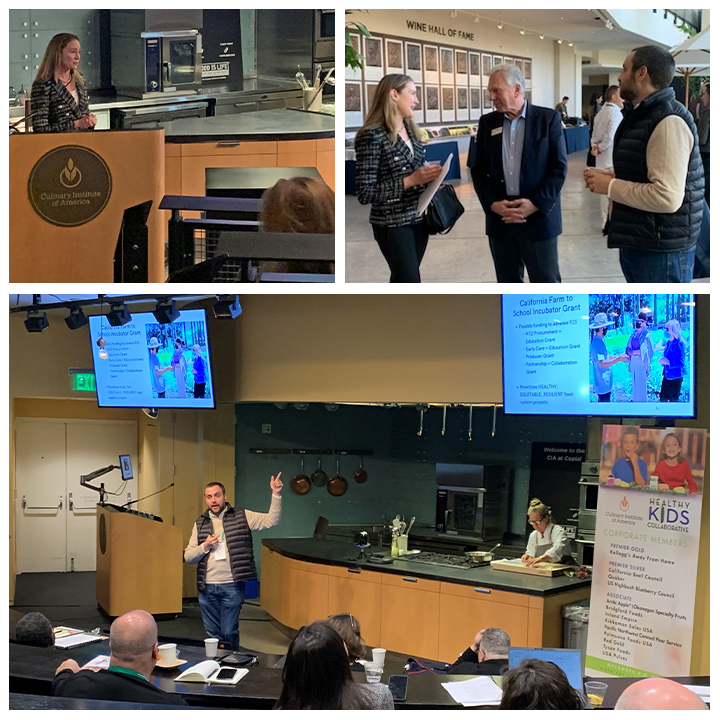

Pictured: the Yolo Farm to Fork project utilizes funds from the Farm to School Incubator Grant Program to pilot a new regional food system, enabling group of specialty crop farmers who use climate-smart agricultural practices to bring more fresh, healthy produce to two school districts and teach farming strategies to student gardeners.
CDFA invites all Californians to join in celebrating October as National Farm to School Month.
Supported by the National Farm to School Network, this is a month for thousands of schools, early care education sites, farms, communities, and organizations across the country to celebrate food education, school gardens, and lunch trays filled with healthy, local ingredients.
It’s also a time for the CDFA Farm to School Program to celebrate grantees of the California Farm to School Incubator Grant Program. Through the support of Governor Newsom and the California Legislature, $8.5 million in grant funding was awarded to 60 farm to school projects across the state in 2021. This funding is supporting local and regional farm to school projects that promote nutrition education, sustainable food production and procurement, and high-quality student experiences. Stay tuned for CDFA announcements coming soon about grantees in the 2022 California Fam to School Incubator Grant Program that will support projects that cultivate equity, nurture students, build climate resilience, and create scalable and sustainable change.
California is a leader in farm to school efforts as First Partner Jennifer Siebel Newsom and CDFA Secretary Karen Ross convened the Farm to School Interagency Working Group and Advisory Committee to establish an equitable, resilient and scalable California farm to school movement. These groups’ efforts led to the release earlier this year of “Planting the Seed: Farm to School Roadmap for Success.” The roadmap offers tips to connect children to locally sourced whole foods in the cafeteria, classroom and garden, and it also provides critical resources to cultivate healthier, climate-smart, and more equitable communities.
“CDFA is proud to be one of the many statewide partners supporting farm to school efforts to connect students from every background with healthy, locally grown food to increase consumption of fruits and vegetables,” said Secretary Ross. “This leads to enhanced academic achievement, a lifelong relationship with nutritious food, and a connection to California’s many farmers and ranchers.”
The California Department of Food and Agriculture (CDFA) joins the Food and Agriculture Organization (FAO) of the United Nations in recognizing today as the third annual International Day of Awareness of Food Loss and Waste.
In a world where the number of people affected by hunger is rising and tons of edible food are lost and/or wasted every day, curbing food loss and waste is essential. Food loss and waste puts unnecessary pressure on the environment, resulting in natural resource depletion and greenhouse gas emissions.
Produce Safety Program inspectors give a food safety presentation in Spanish to more than 50 organic growers at a recent workshop hosted by the Agriculture and Land-Based Training Association (ALBA) in Salinas. (Photo courtesy of ALBA)
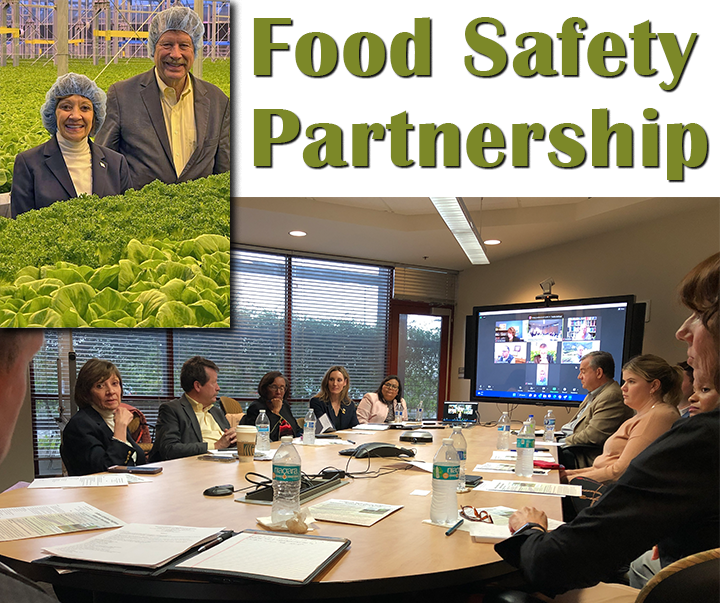
CDFA’s Produce Safety Program works to ensure that California farmers understand how to implement all food safety practices required by the federal Food Safety Modernization Act’s Produce Safety Rule.
As part of PSP’s Educate, Implement and Regulate strategy to accomplish this, three PSP inspectors recently gave a Produce Safety Rule presentation in Spanish to more than 50 organic growers at a workshop hosted by the Agriculture and Land-Based Training Association (ALBA) in Salinas. After the 30-minute presentation, PSP inspectors fielded questions from attendees particular to their small organic farms.
“Thank you CDFA for the Produce Safety Rule workshop,” ALBA posted to its Facebook page (@albafarmers). “It’s important to understand new policies and learn how to stay in compliance. The ultimate goal is to prevent any contamination.”
“Gracias CDFA por el taller de reglas de seguridad de productos agrícolas frescos de hoy. Es importante comprender las nuevas pólizas y aprender a cumplirlas. El objetivo final es prevenir cualquier contaminación.”
Note — In recognition of Hispanic Heritage Month, CDFA wishes to acknowledge the extensive work of ALBA to create opportunities for farmworkers through training in organic farm management, helping them advance their careers or pursue the dream of farm ownership. CDFA Secretary Karen Ross visited ALBA yesterday in Salinas and in the photo below speaks with a grower in the training program tending to kale and broccolini.
Click here to view this original post on CDFA Planting Seeds.
The California Department of Food and Agriculture (CDFA) Technical Assistance Program (TAP) continues to help small-scale farmers across California become compliant with the federal Food Safety Modernization Act (FSMA) Produce Safety Rule for growing fruits, nuts and vegetables. This effort is strengthened through contracts with six multilingual University of California Cooperative Extension (UCCE) specialists.
Recently, TAP’s UCCE specialists provided six one-on-one meetings with growers to provide on-farm assessments. In-person meeting topics included food safety, FSMA compliance, on-farm treatment for pre-harvest and post-harvest ag water, and pesticide illness prevention training.
TAP specialists also held four workshops, three presentations and two webinars about food safety for diverse groups of growers, potential growers and farmworkers. Topics included overall food safety and sessions particular to strawberries and elderberries.
A factsheet, “Preparing for FSMA Inspections: Top 5 Recommendations for Small Farms,” was developed, distributed and translated into Spanish and Simplified Chinese. Work is progressing on a FSMA Inspection Preparation Checklist for modules of Produce Safety Alliance curriculum.
The California Department of Food and Agriculture (CDFA) is announcing two vacancies on the Feed Inspection Advisory Board Technical Advisory Subcommittee (TASC).
This subcommittee provides technical and scientific advice to the Feed Inspection Advisory Board and CDFA on animal food nutrition, safety and efficacy data review of new and unapproved feed ingredients, research project oversight, and other issues that will affect the Commercial Feed Regulatory Program, Livestock Drug Program and Safe Animal Feed Education (SAFE) Program.
Applicants must demonstrate technical, applied and scientific expertise in the fields of toxicology, pathology, and ruminant and non-ruminant nutrition, as well as possess general knowledge about the California feed industry.
The term of office for subcommittee members is three years. Members receive no compensation but are entitled to payment of necessary travel expenses. Individuals interested in being considered for appointment should send a resume and a Feed TASC Prospective Member Appointment Questionnaire (http://www.cdfa.ca.gov/is/ffldrs/pdfs/FIAB-TASC_PMAQ.pdf) to SAFE@cdfa.ca.gov. The application deadline is September 30, 2022.
For further information about the Feed Inspection Advisory Board TASC, please contact CDFA Feed, Fertilizer and Livestock Drugs Regulatory Services branch staff at (916) 900-5022 or visit http://www.cdfa.ca.gov/is/ffldrs/Feed_FIAB.html.
CDFA Karen Ross (speaking in top photo and holding ribbon in bottom photo) participates in last night’s ribbon cutting ceremony for the Food Literacy Center’s new teaching kitchen, outdoor education space, and community garden at Leataata Floyd Elementary School in the Sacramento City Unified School District. California Rep. Doris Matsui (wearing orange and holding scissors in bottom photo) also participated in the event. Secretary Ross was part of the center’s opening ceremony and thanked the Food Literacy Center for all its work helping Sacramento youth develop a lifelong relationship with healthy food and local farmers while inspiring children to eat their vegetables.View this original post on the CDFA Planting Seeds blog.
The California Department of Food and Agriculture (CDFA) California State Organic Program (SOP) contracts with 54 county agricultural commissioner offices to conduct enforcement activities on behalf of CDFA. The enforcement activities include conducting inspections and collecting organic samples for pesticide testing. Pictured are recent SOP organic sampling trainings of county staff at (clockwise from top right) a basil farm in San Mateo County, an apple ranch in Tuolumne County and a strawberry farm in Santa Clara County. Visit the California State Organic Program webpage to learn more about how CDFA protects the organic label through enforcement, education and outreach.
USDA Food and Nutrition Service (FNS) leaders, joined by CDFA Farm to School Program Manager Nick Anicich (top photo, second from left), visit the West Coast Contra Unified School District (WCCUSD) where summer meals were provided in early August. WCCUSD partners with the city, county, state and federal governments, local farmers, non-profits, parents and volunteers to provide healthy meals and increase nutrition awareness. Also at the WCCUSD summer meal site were (bottom right) a local farmer offering samples of stone fruit and Conscious Kitchen (bottom left) offering a variety of berries. The yellow food truck in the top photo, purchased with USDA grant funding, allows WCCUSD to provide summer meals in low-income, remote areas where families may not otherwise have access.
USDA FNS leaders also visited the Alameda County Community Food Bank and the Heart of the City Farmers’ Market in San Francisco, which redeems more nutrition assistance benefits (more than $3 million annually) than any other in the nation.
“Engaging with the partners that administer FNS programs and make them a success, as well as children and families that participate in these programs, is so rewarding,” said FNS Administrator Cindy Long. “It’s a great reminder of why we do what we do here at FNS: to ensure that everyone can access safe, healthy, and nutritious food.”
This is a blog for the California Department of Food and Agriculture (CDFA) Inspection Services Division (ISD). Read here for the latest news about how ISD is providing Californians professional services that support and contribute to a safe, abundant and quality food supply; environmentally sound agricultural practices; and an equitable marketplace for California agriculture.