The California Department of Food and Agriculture’s Fertilizer Research and Education Program (FREP) is now accepting concept proposals for the 2022 grant cycle. FREP’s competitive grant program funds research that advances fertilization practices and minimizes environmental impacts of fertilizing materials.
The 2022 Request for Proposals (RFP) includes several initiatives put forth by the department to help effectively manage fertilizing materials in California agriculture.
This year’s priorities include demonstrating and/or validating management practices that optimize fertilizer and irrigation water use, addressing challenges and barriers to adoption of management practices, technical education, filling knowledge gaps in nitrogen management for specific crops, research on the role of organic input materials in soil nutrient management, understanding nitrogen movement, and investigating mitigation strategies to reduce nitrogen loss.
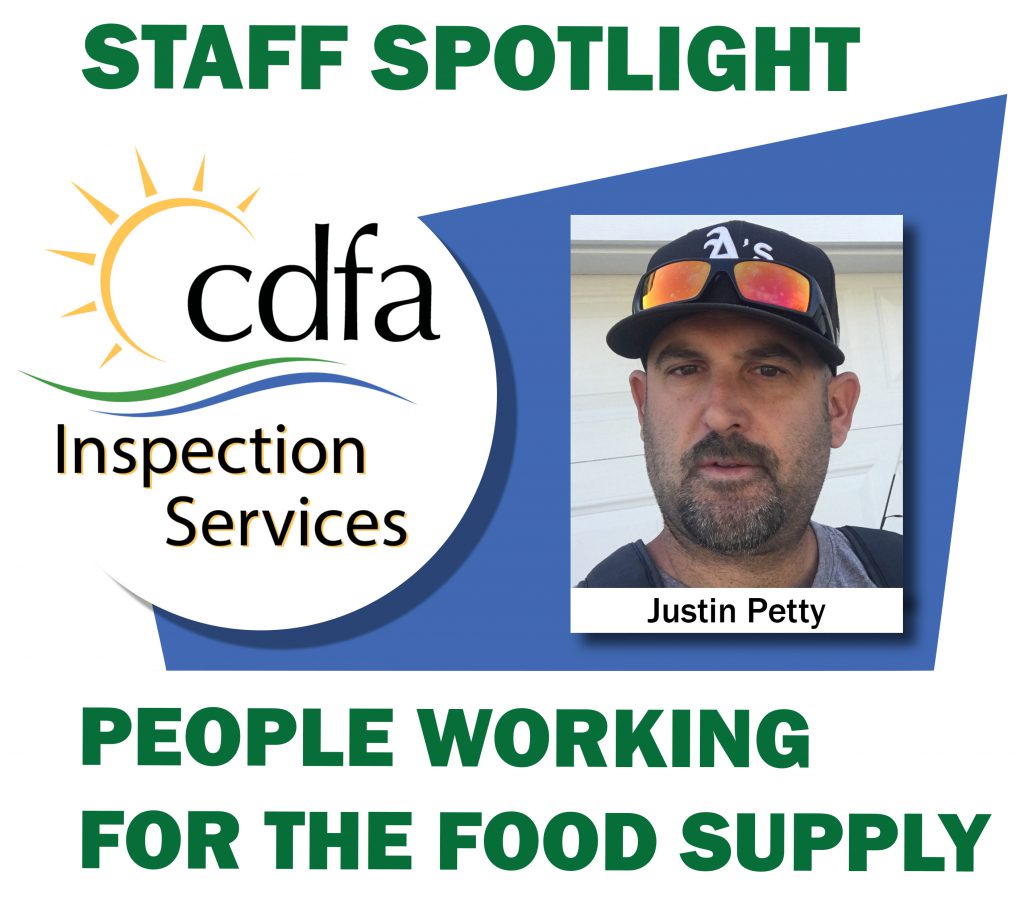
HOW DO YOU WORK FOR THE CALIFORNIA FOOD SUPPLY? I educate and regulate producers of fertilizing materials to assure safe and effective products are available to growers of California’s precious commodities. Sampling of fertilizer products and audits of manufacturers are daily activities that contribute to the quality and effectiveness of fertilizers sold and distributed in California.
THOUGHTS OF WORKING AT INSPECTION SERVICES? I have enjoyed my experiences with the CDFA. I work with people that share the same passion for agriculture as I do. And I think that is important to those we serve. The diverse group of people make our offices interesting and unique.
MEMORABLE MOMENT ON THE JOB? A few weeks on the job, while investigating an issue at a worm casting facility, I asked a barefooted man, dressed in a white tank top with jeans and a cowboy hat, what his job title was? His response: “Head Worm-Wrangler.” I think my training partner and I laughed all the way back to the office.
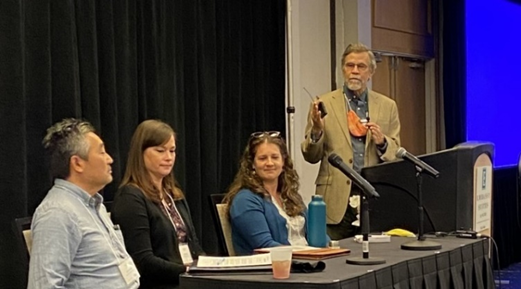
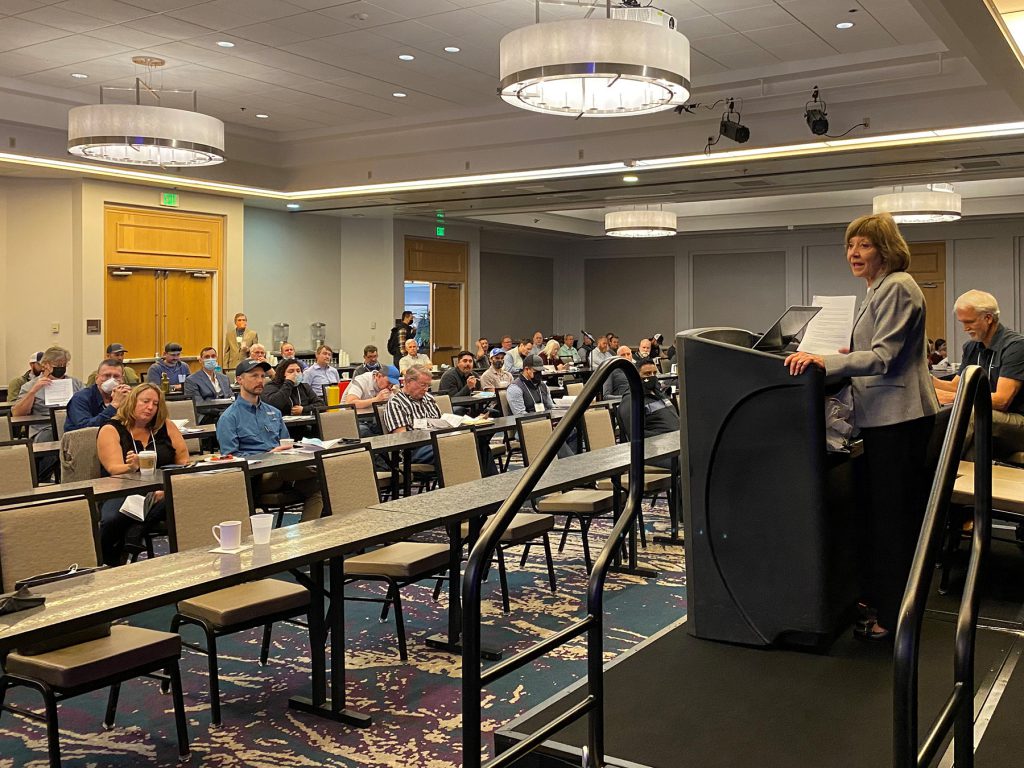
The 2021 Nutrient Management Conference included a panel, “The Evolving Role of Coalitions in the Irrigated Lands Regulatory Program,” which included (R-L) CDFA facilitator Mark Cady and panelists Sarah Lopez, Central Coast Water Quality Preservation Inc., Jodi Switzer, Farm Bureau of Ventura County, and Donald Ikemiya, Kaweah Basin Water Quality Association.
The 29th Fertilizer Research and Education Program (FREP) and Western Plant Health (WPH) Nutrient Management Conference was held in San Luis Obispo, CA, October 27-28, 2021. The conference had more than 100 attendees, including crop consultants, growers, industry representatives, researchers and government personnel.
Check out this California Department of Food and Agriculture (CDFA) FREP blog post for a recap of the event and links to more detailed information about the ongoing research projects presented at the conference.
x x x
Each year since 1990, FREP has funded research, demonstration and education projects related to the environmentally safe and agronomically sound use and handling of fertilizing materials. Visit the FREP Grant Program webpage to learn how to apply for funding and visit the FREP Research & Project Database to see how these research projects are available, understandable and convenient for growers to implement.
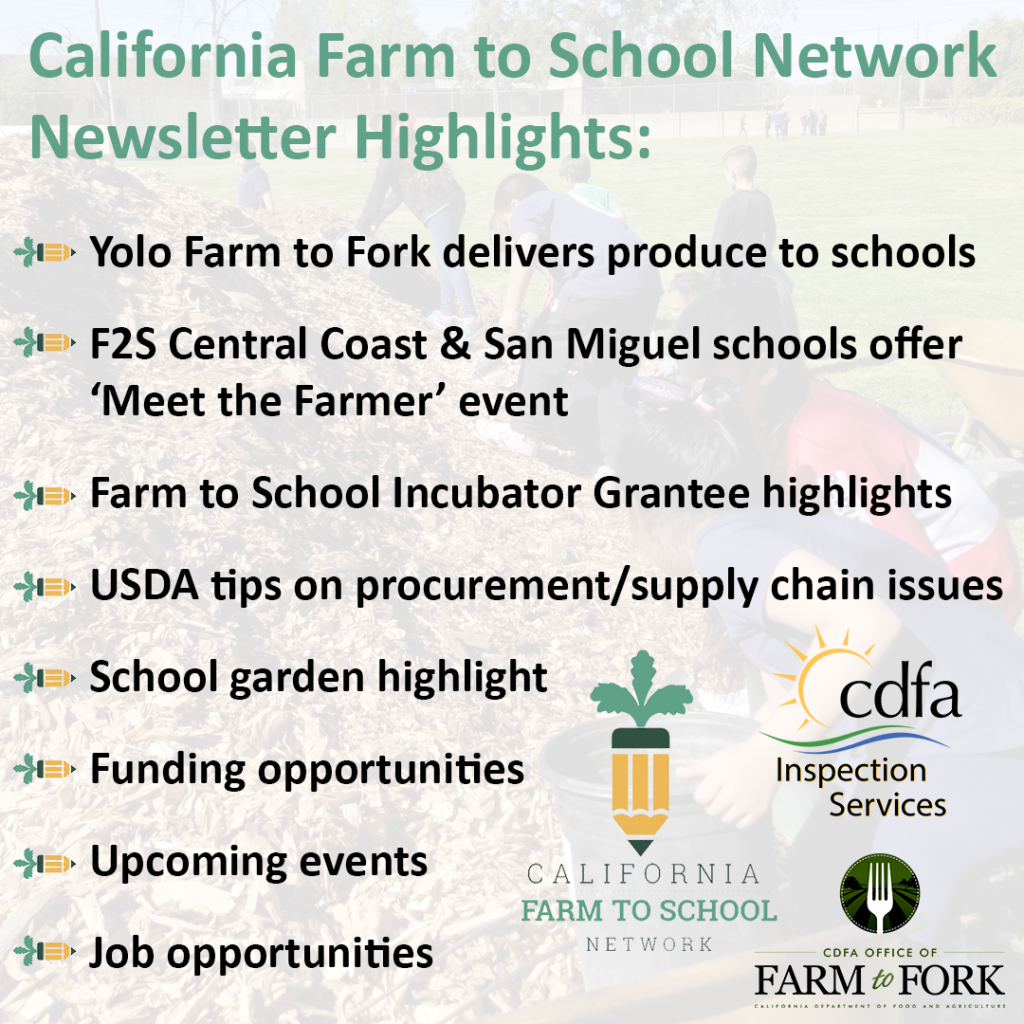
Click here to view the California Farm to School Network November newsletter.
The California Farm to School Network includes farm to school practitioners and enthusiasts statewide. Click on the newsletter subscribe button to also receive these monthly updates that include information about grants, resources, research, webinars, events and news from the National Farm to School Network. The California Farm to School Program is part of the California Department of Food and Agriculture Office of Farm to Fork (CDFA-F2F) in the Division of Inspection Services.
(L-R) Bahar Nakhjavan, Jason Bland and Maryam Khosravifard
California Department of Food and Agriculture (CDFA) Center for Analytical Chemistry (CAC) Environmental Safety Laboratory scientists Bahar Nakhjavan, Jason Bland and Maryam Khosravifard had their article, “Optimization of a Multiresidue Analysis of 65 Pesticides in Surface Water Using Solid-Phase Extraction by LC-MS/MS,” published November 1 in the academic journal Molecules.
The article reviews an improved method developed in the CAC laboratories. Historically, CAC applied a liquid extraction technique to determine 59 pesticide compounds in surface water monitoring. This improved method utilizes a solid phase extraction technique that can determine an expanded 65 compounds. This new technique is faster, simpler, and needs less sample volume (100 ml vs. 1,000 ml) and solvent volume (35 ml vs. 1,000 ml) for extraction, making it more environmentally friendly.
An analytical method was developed and validated for simultaneous quantitation of 65 pesticides, including one single solid-phase extraction (SPE) procedure in surface water by liquid chromatography coupled to tandem mass spectroscopy. Different parameters that have an influence on extraction efficiency were evaluated in this research. Different types of cartridges, elution solvents, and sorbent drying time were investigated, and the most appropriate one was selected. Moreover, various pretreatment techniques were applied to remove sediments from water without the loss of pesticides. Centrifugation was introduced as the best option at the beginning of sample preparation to resolve the clogging of the sorbent cartridges. The recoveries of all pesticides ranged from 70% to 120%, with a relative standard deviation of less than 13.7%. The feasibility of the method was evaluated on 10 surface water samples with different concentrations of sand, sediment, and particles.
Citation
Nakhjavan, B., Bland, J., Khosravifard, M., “Optimization of a Multiresidue Analysis of 65 Pesticides in Surface Water Using Solid-Phase Extraction by LC-MS/MS.” Molecules, 2021, 26 (21), 6627; https://doi.org/10.3390/molecules26216627.
The California Department of Food and Agriculture’s Office of Farm to Fork (CDFA-F2F) announces it is currently accepting proposals for a 2022 California Nutrition Incentive Program (CNIP) expansion for Women, Infants and Children (WIC) and Senior Farmers’ Market Nutrition programs. This CNIP expansion is possible because of a recently announced $20 million increase in CNIP funding as part of an additional $127 million state budget allocation for CDFA-F2F programs.
CDFA’s CNIP provides competitive grant funding to organizations to provide incentives to nutrition benefit shoppers, as well as support program operations and outreach. For this request, CDFA is seeking project proposals from qualified entities to distribute incentives at Certified Farmers’ Markets, Community Supported Agriculture and farm stands throughout California. Incentives should be available to shoppers using WIC and Senior Farmers’ Market Nutrition Program benefits to purchase California grown-fresh fruits and vegetables. Participants should be able to receive the incentive at the time of purchase. Projects that reach underserved populations will be prioritized. This is a competitive process.
Applications must be submitted by email to cafarmtofork@cdfa.ca.gov, no later than 5 p.m. (PST), December 13, 2021. Further information on the grant program, including the Request for Proposals, timeline and application criteria is available at: https://cafarmtofork.cdfa.ca.gov/cnip.html.
The California Department of Food and Agriculture (CDFA) Inspection Services Division (ISD) welcomes Geetika Joshi, Ph.D., as the newly appointed environmental program manager to lead the Produce Safety Program (PSP).
“We’re excited to welcome Geetika to the team as she will work with me, our Inspection and Compliance Branch chief and our PSP team to continue building out the Produce Safety Program and lead food safety efforts in California,” ISD Division Director Natalie Krout-Greenberg said. “Geetika’s education, experience and excitement are the perfect combination to lead the Produce Safety Program into the future.”
CDFA created the PSP to “Educate then Regulate” California farmers about the federal Food Safety Modernization Act (FSMA) Produce Safety Rule under the authority of the U.S. Food and Drug Administration, while working in close partnership with the U.S. Department of Agriculture and California Department of Public Health. FSMA was passed in 2011 to help prevent foodborne illness outbreaks.
Geetika earned a master’s degree in microbiology from the University of Delhi (India) and a doctoral degree in soils and biogeochemistry with a biotechnology emphasis from UC Davis. Her background includes post-doctoral work at the UC Davis Center for Regional Change. Geetika joined CDFA in 2014 to help establish the Dairy Digester Research and Development Program (DDRDP), which evolved to become part of CDFA’s Office of Environmental Farming and Innovation (OEFI). In 2017, Geetika started serving as supervising senior environmental scientist for the DDRDP, Alternative Manure Management Program and Healthy Soils Program while assisting other OEFI programs as needed. Geetika has represented CDFA at multiple conferences, including being a regular presenter at the California Bioresources Alliance Symposium and Coalition on Agricultural Greenhouse Gases Conference. She also has represented CDFA on the U.S. Biogas Mission to Denmark in 2018, Almond Board Conference 2020, Soil Science Society of America and more. Geetika has worked closely with various sectors of the California agriculture industry.
California Department of Food and Agriculture (CDFA) Secretary Karen Ross welcomes attendees Wednesday morning to the 29th Nutrient Management Conference hosted by the CDFA Fertilizer Research and Education Program (FREP) and Western Plant Health (WPH) at Embassy Suites in San Luis Obispo. Secretary Ross’ comments included an update on State Budget impacts to CDFA and FREP, as well as funding opportunities and new initiatives important to the crop advisors, academics and industry representatives in attendance. The annual FREP/WPH Nutrient Management Conference brings together industry professionals and academic researchers to learn about and share the latest research and innovative management practices for fertilizing materials.
Visit www.cdfa.ca.gov/is/ffldrs/frep/FREPConference.html to view this year’s conference agenda and see current and past conference proceedings. Conference protocols are adhering to state and local health guidelines.
SACRAMENTO, October 25, 2021 – The California Department of Food and Agriculture (CDFA) Fertilizer Research and Education Program (FREP) is announcing $4.14 million in grant funding to agricultural organizations and universities.
The funding includes $3 million for the University of California, Agricultural and Natural Resources (UCANR) to conduct targeted nitrogen and irrigation education and training in California’s Central Valley and Central Coast and $1.14 million for five research and education projects to advance California growers’ understanding and implementation of improved nitrogen and irrigation management practices.
Each year since 1990, FREP has funded research, demonstration and education projects related to the environmentally safe and agronomically sound use and handling of fertilizing materials. Visit the FREP Grant Program webpage to learn how to apply for funding and visit the FREP Research & Project Database to see how these research projects are available, understandable and convenient for growers to implement.
It was recently announced that an additional $60 million from the state budget has been allocated to sustain and expand the grant program through 2023. Visit CDFA’s California Farm to School Program page for grant updates.
San Luis Coastal Unified connects local food into nutrition and lessons
San Luis Coastal Unified School District’s farm to school activities will continue and grow through the CDFA Farm to School Incubator Grant Program.
CA Farm to School Incubator Grantee San Luis Coastal Unified School District (SLCUSD) does it all! From procuring local foods for school meals to teaching students about where their food comes from, SLCUSD has been a driving force in the farm to school community and we are so excited to see its work grow through CDFA’s Farm to School Incubator Grant! For its grant project, SLCUSD will procure foods from local farms and school gardens, integrate these foods into recipes for the school meal program and tasting opportunities for students, teach students about the local foods served in school meals through classroom lessons that connect to Common Core Standards, maintain school gardens and provide garden lessons, and coordinate Meet the Farmer events for students.
Farm to Institution Center supports Oceanside Unified and Fallbrook Union High School districts
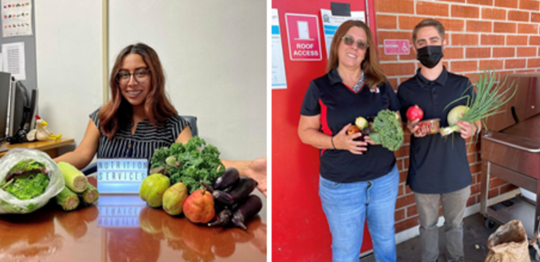
Farm to Institution Center staff (Instagram: @f2icenter)
The Farm to Institution Center is using grant funds to establish the Inspiring Local Food Connections (ILFC) program. A partnership between Oceanside Unified School District (OUSD) and Fallbrook Union High School District (FUHSD), the project supports and expands farm to school procurement and education to inspire the next generation of food system advocates. As part of the ILFC program, nutrition service staff members at OUSD and FUHSD received “fresh five” bags from Foodshed (a 100% farmer-owned operation!) before autumn equinox. These bags included a variety of local produce including kale, Japanese eggplant, corn, red pears, kohlrabi microgreens, green onions, cherry tomatoes and honeydew melon!
Ocean View Elementary School District implements an Edible Education Program
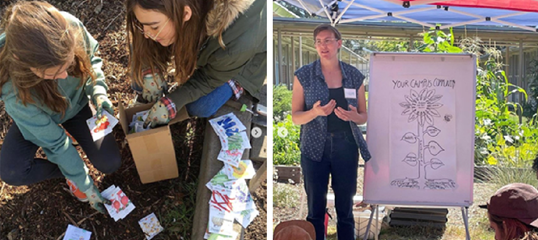
Ocean View School District Presents Edible Education at Baby Root Farm.
Ocean View Elementary School District (OVESD) is using its Farm to School Incubator Grant funds to implement an Edible Education Program that will bridge the gap between the local food items served in school meals and what students are learning in the classroom. In partnership with Edible Ojai and Ventura County, OVESD is developing and distributing monthly Edible Education units that include: lesson plans for teachers with suggestions for connecting the unit to the school meals in the cafeteria; farmer trading cards for each K-8 student featuring the farmer who provided the local food served at lunch; accompanying farmer posters for the cafeterias; Edible Education booklets with an in-depth profile of the farmer and their climate smart agricultural practices; and recipes highlighting the local food item that the district purchased from the farmer. Check out these Edible Education units the district has developed so far:
This is a blog for the California Department of Food and Agriculture (CDFA) Inspection Services Division (ISD). Read here for the latest news about how ISD is providing Californians professional services that support and contribute to a safe, abundant and quality food supply; environmentally sound agricultural practices; and an equitable marketplace for California agriculture.