

Click here to view the April newsletter.
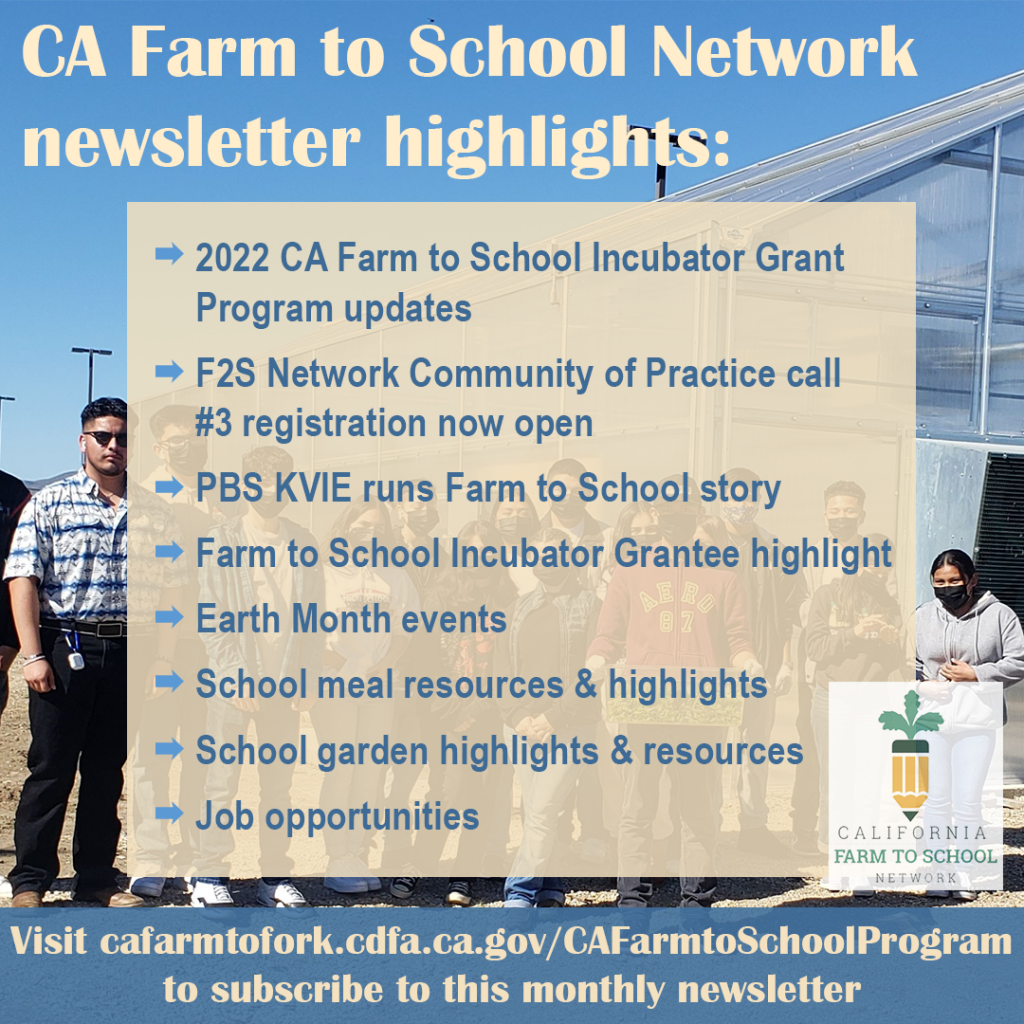


Click here to view the April newsletter.
Click here to read the California Department of Food and Agriculture (CDFA) Commercial Feed Regulatory Program spring 2022 Quarterly Feed Update.
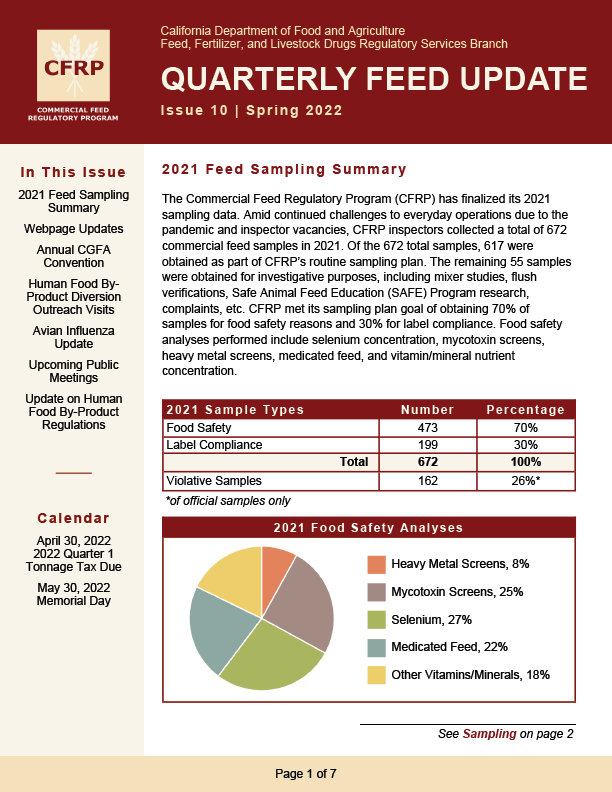
View this and previous newsletters on the Commercial Feed Regulatory Program (CFRP) Quarterly Feed Update Newsletter webpage. CFRP is part of the Feed, Fertilizer and Livestock Drugs Regulatory Services Branch of CDFA’s Division of Inspection Services.
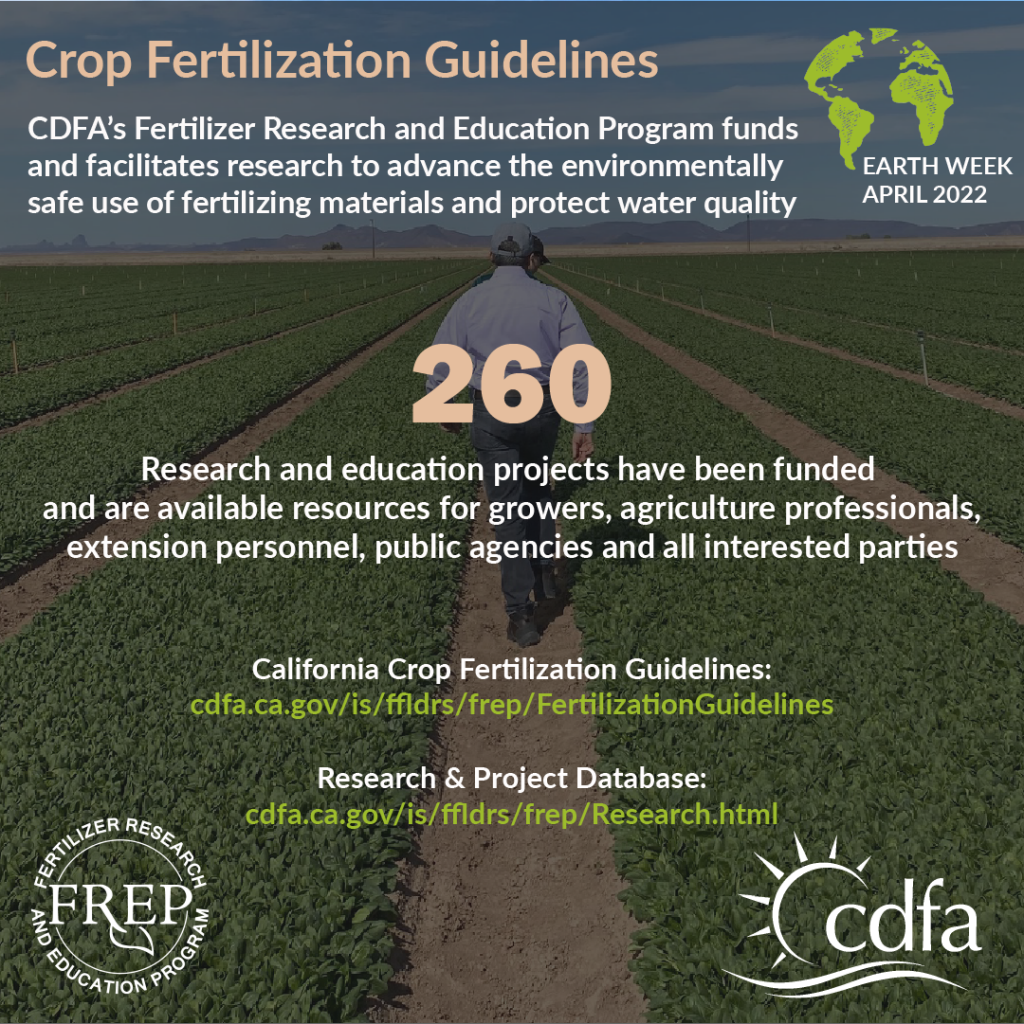
The California Department of Food and Agriculture (CDFA) Fertilizer Research and Education Program (FREP) blog, Research Update: Nitrogen Management for Container Plant Production, reviews a FREP-funded project measuring nitrogen (N) input and output from a woody ornamental plant production system to understand the fate of incorporated controlled-release and surface-applied fertilizer.
Background: A large proportion of groundwater in the Central Valley is currently experiencing nitrate contamination because of inefficient irrigation and fertilization. The Central Valley Regional Water Quality Control Board requires growers to complete an Irrigation and Nitrogen Management Plan (INMP) annually to document N inputs and outputs from production areas. Existing knowledge gaps prevent wholesale container plant growers from accurately filling out the INMP Worksheet. To assist growers in filling out the INMP Worksheet, a system N balance was developed for a woody ornamental nursery production system.
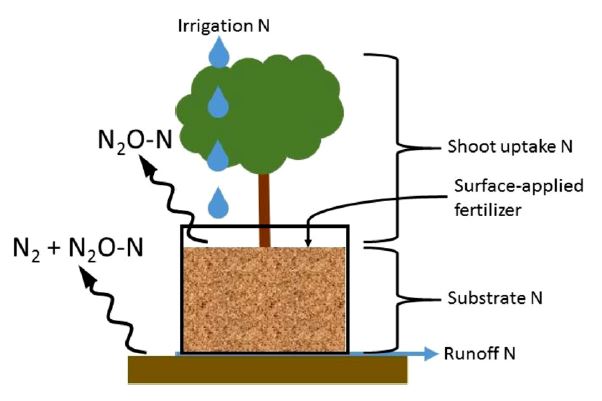
Approach: A woody ornamental was grown for 81 days in containers filled with Douglas fir bark soilless substrate. The experiment consisted of four lined and four unlined experimental beds for runoff capture. Nitrogen inputs measured included: substrate with controlled-release fertilizer and roots incorporated, irrigation water, and surface-applied fertilizer (Figure 1). Harvested product N outputs included: the substrate, including roots and remaining fertilizer, and plant shoots at end of the production cycle (Figure 1). Additional outputs included gaseous N emitted from the substrate and aqueous N that was leached from the substrate or applied as irrigation water and flowed off the growing beds during the production cycle (Figure 1).
Results: View the FREP blog.
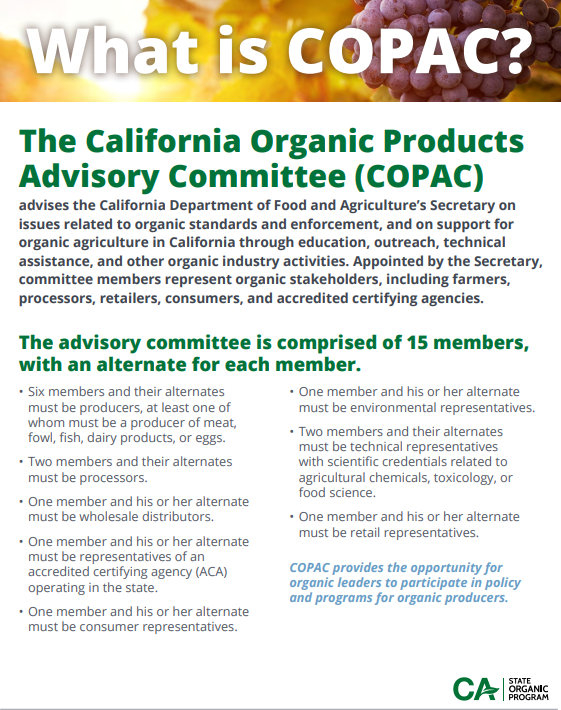
The California Department of Food and Agriculture (CDFA) is announcing vacancies on the California Organic Products Advisory Committee (COPAC).
COPAC advises the CDFA secretary on matters pertaining to the California State Organic Program (SOP). The SOP is responsible for enforcement of federal and state laws governing organic production, and administration of the organic program in the state. There are currently more than 4,700 organic operations registered with CDFA.
The current vacancies include wholesale distributor representative; technical representative; consumer representative; producer representative alternate; wholesale distributor representative alternate; processor representative alternate; retail representative alternate; environmental representative alternate; technical representative alternate; and consumer representative alternate.
The term of office for committee members is three years. While members do not receive compensation, they are entitled to payment of necessary traveling expenses in accordance with the rules of the California Department of Human Resources.
Individuals interested in being considered for an appointment should complete the Prospective Member Appointment Questionnaire (PMAQ) available at https://www.cdfa.ca.gov/is/organicprogram/pdfs/copac/COPAC-PMAQ.pdf and obtain a letter of recommendation from an industry member. Applications will be accepted until the positions are filled.
Applications should be sent to Thomas Osborn, CDFA Inspection and Compliance Branch, 1220 ‘N’ Street, Sacramento, CA 95814 or via e-mail to Thomas.Osborn@cdfa.ca.gov.
For further information on the California State Organic Program and COPAC vacancies, contact Danny Lee via email at Danny.Lee@cdfa.ca.gov.
The California Department of Food and Agriculture Office of Farm to Fork (CDFA-F2F) is currently accepting proposals for the 2022 California Nutrition Incentive Program (CNIP). The intent of this request for proposals (RFP) is to solicit project proposals that CDFA-F2F may combine into one California application for federal funding of up to $31 million through the USDA Nutrition Incentive Program.
CNIP supports shoppers using nutrition benefits such as CalFresh by providing a dollar-for-dollar match for every benefit dollar spent on fruits and vegetables at participating sites. CNIP incentives enable benefit recipients to purchase nutritious, locally grown fresh fruits and vegetables for their families while supporting California farmers.
For this request, CDFA-F2F is seeking project proposals from qualified entities to distribute incentives at Certified Farmers’ Markets, Community Supported Agriculture sites, farm stands, and small brick and mortar retailers throughout California.
Applications must be submitted by email to cafarmtofork@cdfa.ca.gov, no later than 6 p.m. (PDT), May 16, 2022. Further information on the grant program, including the RFP, timeline and application criteria are available at: https://cafarmtofork.cdfa.ca.gov/cnip.html.
CNIP supports locally grown produce and improves nutrition access and security for all Californians. Governor Newsom and the California Legislature have continually offered an investment of state funds to leverage federal grants to support this nutrition equity initiative.
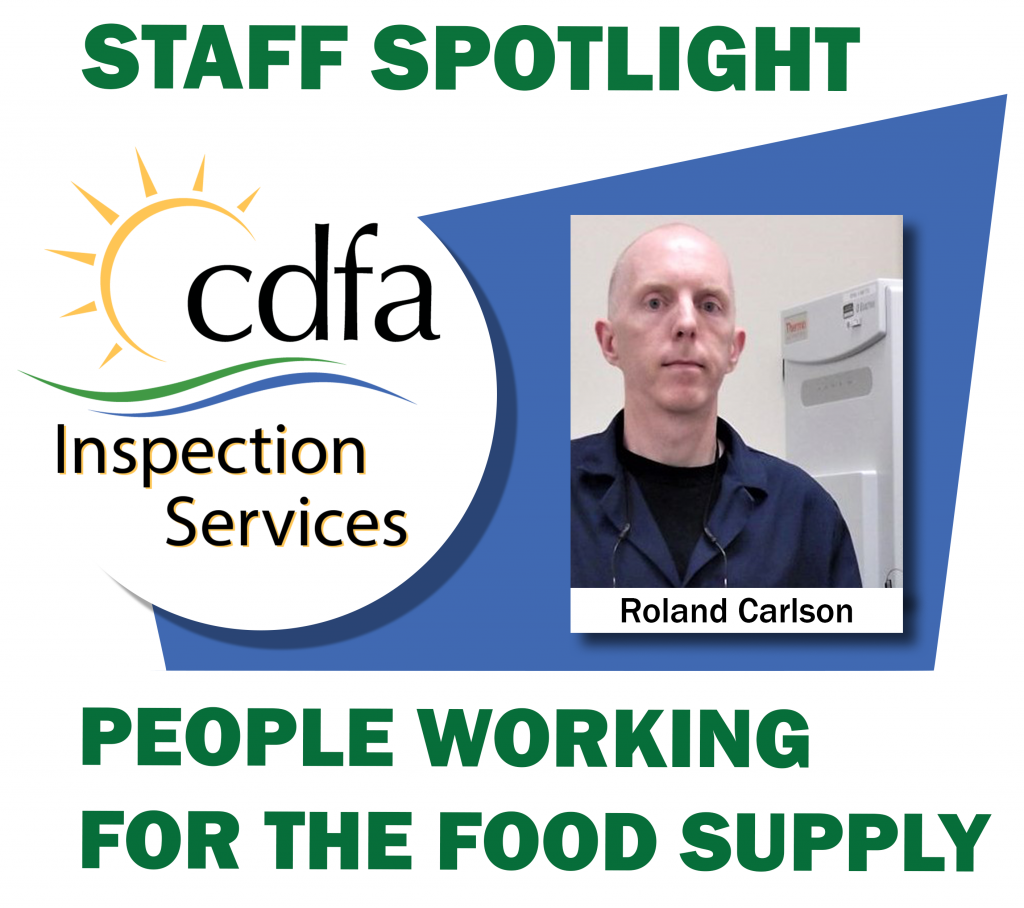
NAME: Roland Carlson
YEARS AT CDFA: 15
PROGRAM: Center for Analytical Chemistry (CAC) Food Safety (FS) Laboratory
TITLE: Senior Environmental Scientist
HOW DO YOU WORK FOR THE CALIFORNIA FOOD SUPPLY? Our FS laboratories ensure the safety of produce sold in California by monitoring fruits and vegetables through a unique combination of our expertise and top-of-the-line technology. Our high-quality analyses and data points also are used to demonstrate the high quality of California’s food supply nationwide and in international markets.
THOUGHTS OF WORKING AT INSPECTION SERVICES? I feel exceptionally fortunate to have had the opportunity to work at CAC for the last 15 years. Everyone in the FS laboratories works hard to provide the highest quality data in a timely manner. It’s a very dedicated group of people. I’ve had many opportunities to learn and to apply creativity in solving problems. I’ve also had some great opportunities to collaborate with colleagues at other laboratories. There are still a lot of interesting challenges as we expand the scope of our analysis to include things like emerging contaminants or difficult sample types such as hemp and cannabis.
MEMORABLE MOMENT ON THE JOB? It’s not a particular moment, but implementing new instrumentation can be a long process from making the choice of a particular technology, going through the procurement, facilitating the installation and developing the software for our analytical application. It was particularly memorable and satisfying when we upgraded to the latest generation of LCMS (liquid chromatography mass spectrometry) instrumentation for our routine analysis because the quality of the data was dramatically improved compared with what we could achieve with the previous generation instruments. In addition, we were able to significantly expand the number of analytes we were testing for and decrease detection limits.
FAVORITE TV SHOW? The best I recently watched was “Mr. Robot.”
USDA News Release
The U.S. Department of Agriculture (USDA) has announced the launch of the Meat and Poultry Processing Capacity Technical Assistance Program (MPPTA) to provide technical assistance to meat and poultry grant applicants and grant-funded projects. Processors and applicants involved with the Meat and Poultry Inspection Readiness Grant (MPIRG) program and the Meat and Poultry Processing Expansion Program (MPPEP) can access this technical assistance. USDA also announced it is now accepting applications for $23.6 million in competitive grant funding available through the MPIRG program.
Meat and Poultry Processing Capacity Technical Assistance Program (MPPTA)
As part of Biden-Harris Action Plan for a Fairer, More Competitive, and More Resilient Meat and Poultry Supply Chain, USDA’s Agricultural Marketing Service (AMS) has established cooperative agreements with three non-profit organizations to coordinate and provide technical assistance utilizing a wide range of expertise and outreach strategies. These organizations will also establish a national network of support for meat and poultry grant applicants to navigate the application process, and to assist grant recipients throughout their project.
“This is a true partnership to help meat and poultry processors and grant applicants diversify processing ownership throughout the country,” said Agriculture Secretary Tom Vilsack. “Meat and poultry processing is a complex sector that requires significant planning and forethought to manage economic viability concurrently with worker, food, and environmental safety. We are pleased to partner with these initial organizations, given their deep technical expertise and demonstrated service to underserved communities, as part of our support for fairer, more competitive, and resilient meat and poultry supply chains.”
Taking the lead role, the Flower Hill Institute, a native owned nonprofit based out of the Jemez Pueblo in New Mexico, will serve as the MPPTA Technical Assistance Coordinator for this multi-year program. In close cooperation with AMS, they will connect USDA grant applicants and grant-funded project managers to the experts best suited to support a project’s needs. They are joined by Oregon State University’s Niche Meat Processors Assistance Network and the Intertribal Agricultural Council. USDA is also pursuing agreements with the American Association of Meat Processors, the American Meat Science Association, and the Agricultural Utilization Research Institute to expand assistance and provide the depth and capacity needed for meat and poultry projects nationwide. All MPPTA organizations will use both in-house resources and their connections within the industry, academia, and state and federal government to connect stakeholders to four distinct technical assistance scopes: federal grant application management; business development and financial planning; meat and poultry processing technical and operational support; and supply chain development.
To learn more about the MPPTA program, or to initiate a request for technical assistance under this program, visit the AMS webpage www.ams.usda.gov/services/grants/mppta. For information on MPIRG, MPPEP, and USDA’s other Meat and Poultry Supply Chain Initiatives, visit www.usda.gov/meat.
Meat and Poultry Inspection Readiness Grants (MPIRG)
AMS is accepting applications now through May 24, 2022 for a second round of MPIRG program funding totaling $23.6 million.
“We are building on the success of the first round of our MPIRG program to build capacity and increase economic opportunities for small and mid-sized meat and poultry processors and producers around the country,” said Secretary Vilsack. “In the MPIRG program’s first round, we provided $32 million in funding to cover the costs for necessary improvements to achieve a Federal Grant of Inspection under the Federal Meat Inspection Act or the Poultry Products Inspection Act, or to operate under a state’s Cooperative Interstate Shipment program. And the second round will help us continue to help processors grow.”
USDA encourages grant applications that focus on improving meat and poultry slaughter and processing capacity and efficiency; developing new and expanding existing markets; increasing capacity and better meeting consumer and producer demand; maintaining strong inspection and food safety standards; obtaining a larger commercial presence; and increasing access to slaughter or processing facilities for smaller farms and ranches, new and beginning farmers and ranchers, socially disadvantaged producers, and veteran producers.
Eligible meat and poultry slaughter and processing facilities must be operational and not have a Federal Grant of Inspection or comply with the Cooperative Interstate Shipment program at the time of application. These entities include commercial businesses, cooperatives, and tribal enterprises. MPIRG’s Planning for a Federal Grant of Inspection project type is for processing facilities currently in operation and are working toward Federal inspection. Applicants can be located anywhere in the states and territories. MPIRG’s Cooperative Interstate Shipment Compliance project type is only for processing facilities located in states with a Food Safety Inspection Service (FSIS) CIS program. These states currently include Indiana, Iowa, Maine, Montana, Missouri, North Dakota, Ohio, South Dakota, Vermont and Wisconsin. Applicants must be working toward CIS program compliance requirements to operate a state-inspected facility or make a good faith effort toward doing so. Potential applicants should contact FSIS to determine the expenses necessary to obtain a Federal Grant of Inspection or comply with the CIS program.
Applications must be submitted electronically through www.grants.gov by 11:59 p.m. Eastern Time on May 24, 2022. Any grant application submitted after the due date will not be considered unless the applicant provides documentation of an extenuating circumstance that prevented their timely submission of the grant application. Read more in AMS Late and Non-Responsive Application Policy (PDF, 246 KB).
AMS offers webinars for new applicants to help walk them through the application process while also providing helpful hints on what has made past recipients successful. Additionally, grants management specialists are standing by to answer any incoming questions and emails during regular business hours. For more information about grant eligibility and previously funded projects, visit the MPIRG webpage, or contact us at mpirg@usda.gov.
USDA is also extending to May 11, 2022, the application deadline for the Meat and Poultry Processing Expansion Program (MPPEP), which provides funding to expand meat and poultry processing capacity. For additional information, applicants and other interested parties are encouraged to visit the MPPEP website: rd.usda.gov/mppep. Questions may be submitted through the website or sent to MPPEP@usda.gov.
The California Department of Food and Agriculture (CDFA) announces one vacancy on the Fertilizer Inspection Advisory Board. The board advises the CDFA secretary on CDFA’s Fertilizing Materials Inspection Program (FMIP), which ensures fertilizing materials are safe, effective and meet quality guarantees.
As part of the program, FMIP inspectors and investigators located throughout the state conduct routine sampling and inspections, respond to consumer complaints, and enforce laws and regulations that govern the manufacturing and distribution of fertilizing materials. FMIP is funded by fertilizing materials license and product registration fees and mill assessments.
There is one board position available. The term of office for board members is up to three years. This vacancy will fill an unfinished board term of service until October 14, 2022. Board members do not receive compensation, but they are entitled to necessary travel expenses. Board member applicants must hold a current fertilizing materials license or be a representative of a licensed firm.
Individuals interested in a board appointment must submit a resume and a completed Prospective Member Appointment Questionnaire (PMAQ). The PMAQ is available on the CDFA website at http://www.cdfa.ca.gov/is/ffldrs/pdfs/PMAQ_Fertilizer_IAB.pdf. Both the resume and PMAQ are due by April 15, 2022.
Send resume and PMAQ via email to Brittnie.Williams@cdfa.ca.gov or by mail to:
CDFA
Feed, Fertilizer and Livestock Drugs Regulatory Services Branch
Attn: Brittnie Williams
1220 N Street
Sacramento, CA 95814
For more information, contact Brittnie Williams at (916) 900-5022 or Brittnie.Williams@cdfa.ca.gov.
From the U.S. Food and Drug Administration
The U.S. Food and Drug Administration (FDA) released a new user-friendly online Agricultural Water Assessment Builder to help farms understand the proposed requirements for an agricultural water assessment in the Agricultural Water Proposed Rule. Use of the tool is optional.
If finalized, the proposed rule would require farms to conduct systems-based agricultural water assessments to determine and guide appropriate measures to minimize potential risks associated with pre-harvest agricultural water. The assessment would include an evaluation of the water system, agricultural water use practices, crop characteristics, environmental conditions, potential impacts on source water by activities conducted on adjacent and nearby land, and other relevant factors, such as the results of optional testing. Covered farms would be required to conduct pre-harvest agricultural water assessments annually, and whenever a significant change occurs that affects the likelihood that a known or reasonably foreseeable hazard will be introduced into or onto produce or food contact surfaces.
The Agricultural Water Assessment Builder prompts users to answer questions and/or fill in information specific to their farms. Information entered into the tool is not shared with the FDA and will not be saved. However, users have the opportunity save or print the information they provide to their local computers.
This user-friendly tool incorporates information from the Agricultural Water Proposed Rule, the Final Qualitative Assessment of Risk to Public Health from On-Farm Contamination of Produce, and the 2015 Produce Safety Final Rule.
The development of this tool is consistent with FDA’s objectives in the New Era of Smarter Food Safety Blueprint to look for smarter tools and approaches for food safety. FDA welcomes feedback on this optional tool, such as suggestions related to the tool’s functionality and, usability. Feedback on the tool can be sent to agwaterbuilder@fda.hhs.gov.
For Additional Information
X X X
Visit the CDFA Produce Safety Program website for more information about the requirements of the Produce Safety Rule under the Food Safety Modernization Act. View this FDA Constituent Update on the Produce Safety Program blog, where you can join the mailing list for CDFA announcements about how the Produce Safety Rule affects California farmers.