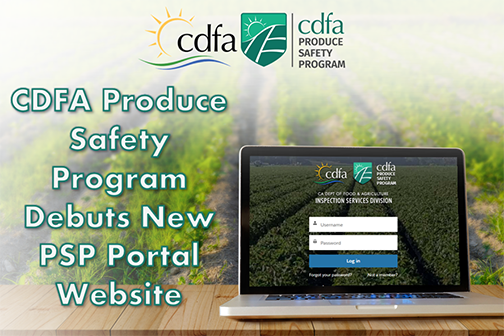
The California Department of Food and Agriculture (CDFA) Produce Safety Program (PSP) announces the official launch of its new Farm Data Repository website for California farms and farm inspections to support statewide compliance with the Food Safety Modernization Act (FSMA) Produce Safety Rule. Also known as the PSP Portal, this new digital resource provides California produce growers and handlers the ability to:
View their own inspection reports related to their own farms online.
Engage and respond to inspection-related action items digitally, including document uploads.
Communicate conveniently with CDFA PSP staff members.
Click here for more details on the Produce Safety Rules! Blog.
The California Department of Food and Agriculture’s Office of Farm to Fork (CDFA-F2F) announces that applications are being accepted until October 11 for the California Nutrition Incentive Program (CNIP) 2025 round of competitive grant funding.
The intent of this request for proposals (RFP) is to select project proposals to combine into one unified state application for CDFA-F2F submission to the U.S. Department of Agriculture’s Gus Schumacher Nutrition Incentive Grant Program (GusNIP). CNIP is also accepting proposals that cover the gap between current GusNIP-funded programs and the anticipated next round.
CDFA’s CNIP provides competitive grant funding to organizations to provide incentives to nutrition-benefit shoppers, and also to support program operations and outreach. For this request, CDFA-F2F is seeking project proposals from qualified entities to distribute incentives at Certified Farmers’ Markets, Community Supported Agriculture sites, farm stands, and brick and mortar retailers throughout California. Incentives should be available to shoppers using CalFresh benefits to purchase California-grown fresh fruits and vegetables.
Applications must be submitted by email to cafarmtofork@cdfa.ca.gov no later than 5 p.m. (PDT) October 11, 2024. Further information about the grant program, including the RFP, timeline and application criteria, are available at https://cafarmtofork.cdfa.ca.gov/cnip.html.
Click here to view this original CDFA press release.
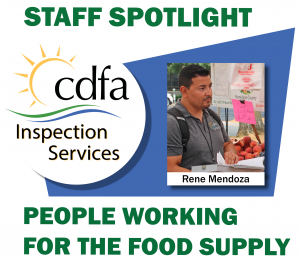
USUAL DAILY ACTIVITIES ON THE JOB?Typical daily tasks and responsibilities may involve various activities such as: Conducting statewide field inspections; in the field, training County Agriculture Commissioner’s Office staff; addressing and following up on industry complaints or issues related to Direct Marketing; offering clarification and guidance on Direct Marketing laws and regulations; and guiding and assisting in investigations, especially in complex cases involving certified producers operating in multiple counties.
HOW DO YOU WORK FOR THE CALIFORNIA FOOD SUPPLY?By helping ensure compliance in the Direct Marketing Program’s Central District area that allows California farmers with an opportunity to sell their produce directly to consumers, bypassing additional costs such as packaging and sizing requirements / regulations. Furthermore, it enables customers to engage with farmers, gain insight into their farming methods and appreciate the origins of the food they consume.
THOUGHTS ON WORKING AT INSPECTION SERVICES?Every day is different. I enjoy working for Inspection Services as it gives me a feeling of making a positive impact in our California food supply. I like the unique experiences that come with each workday, from meeting new individuals to continually acquiring knowledge.
MEMORABLE MOMENT ON THE JOB?Tough question. There have been many memorable moments, but one that particularly stands out is from when I initially joined the Direct Marketing Program. During a production site inspection, I had the opportunity to meet a small-scale grower in the San Joaquin Central Valley who was successfully cultivating papayas in the valley. In addition to papayas, he was growing an array of high-quality, gorgeous fruits and vegetables including sugar cane, taro, jujubes, various greens, gourds and eggplant. The very friendly farmer was enthusiastic to showcase his entire operation, and although I later had many similar encounters, this was one of my first that contributed to my knowledge of Asian Specialty vegetables.
PHILOSOPHY OF LIFE? Approach situations with an open mind and nurture positive relationships.
The California Department of Food and Agriculture (CDFA) Fertilizer Research and Education Program (FREP) Grant Program annually funds research projects related to the environmentally safe and agronomically sound use and handling of fertilizing materials in California.
Enhancing Nitrogen and Water Use Efficiency in California Carrot Production Through Management Tools and Practices
Project Location: Imperial and Kern counties
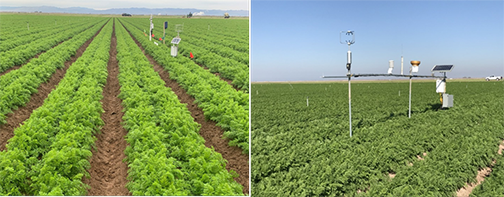
Overview: The purpose of this project was to understand the viability and applicability of current nitrogen and irrigation management practices in California carrot production. The project aimed to develop knowledge and information on improving and promoting adoption of management practices that optimize nitrogen and irrigation water use efficiency in addition to developing new information on nitrogen (N) uptake curves, net N removal, and crop water use. Data from the project was also used to add carrots to CropManage, a web-based tool for water and N management.
Highlights:
Carrots are typically over-irrigated during plant establishment.
N uptake curve was developed for desert carrot; 50% of N uptake occurs between 80-130 days after seeding.
N application rates greater than 145 pounds per acre do not have a significant impact on carrot root yield in a well-managed irrigated field.
CropManage carrot module was developed and evaluated for carrot fields in the low desert region.
An average N removal of 3.0 pounds per ton of fresh carrot root was determined for desert carrots.
Click here to read more about this project in a FREP Research Update blog.
Immobilization of Nitrate in Winter-Fallow Vegetable Production Beds to Reduce Nitrate Leaching
Project Location: Commercial farms on the Central Coast
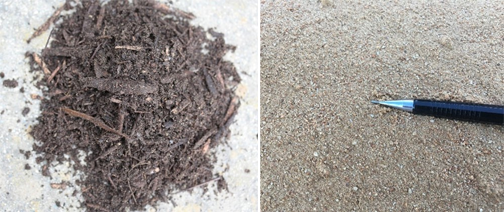
Overview: This project evaluated the use of high carbon (C) amendments to reduce nitrate leaching in winter fallow vegetable crop beds. The researchers identified two primary high C materials, a local, inexpensive and abundant green waste material called Forest Mulch and almond shells from the Central Valley. Laboratory incubations and large-scale field trials in commercial vegetable fields were conducted to look at how effectively different particle sizes and application rates of these materials immobilized nitrate and prevented leaching. In-field starter fertilizer trials were also completed to examine the impact of high C amendments on the yield of the subsequent crop. Finally, an economic analysis of the costs associated with using Forest Mulch and almond shells was carried out to examine the feasibility of their use.
Key Takeaways:
Ground almond shells are a viable high C amendment, while the Forest Mulch green waste is not effective at immobilizing soil nitrate.
The optimal particle size for using ground almond shells as a high C amendment are ¼ to ½ inch. Applications need to be 5 to 10 tons/acre (T/A) to be effective.
Applying starter fertilizer can adequately overcome immobilization occurring after high C material application rates with no adverse effect on yield.
Trucking and grinding costs are likely to make the practice of applying almond shells too expensive at the rates required to effectively immobilize soil nitrate-N for most growers at this time.
Click here to learn more about this project in a FREP Research Update blog.
If interested in receiving FREP’s Bringing Research into Practice quarterly newsletter that highlights FREP-funded research projects, visit the FREP Blog and subscribe at the top right of the webpage.
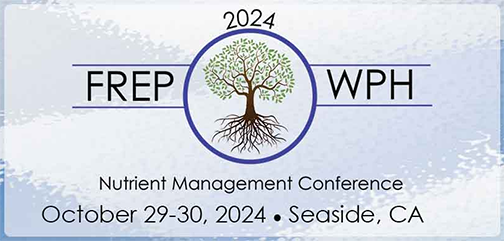
Registration is now open for the 32nd Annual Nutrient Management Conference, hosted by CDFA’s Fertilizer Research and Education Program (FREP) and Western Plant Health (WPH). This year’s conference will be held October 29-30 at the Embassy Suites by Hilton Monterey Bay, Seaside, CA, and includes a pre-conference tour of McFadden Woodchip Bioreactor in Salinas 2-4 p.m. October 28.
The Nutrient Management Conference annually brings together industry professionals and academic researchers to learn about and share the latest research and innovative management practices related to fertilizing materials and irrigation. This year’s conference includes presentations on irrigation and nutrient management in annual and perennial crops, fertilizer uses, managed aquifer recharge, soil sampling and laboratory techniques, biostimulants, nutrient management in regenerative agriculture and two panel discussions: nitrogen removal coefficients and nutrient and irrigation management in organic systems. In addition, there will be two interactive workshops on adjusting irrigation pH and approaches for collaborating with small and underserved growers.
Early conference registration (through October 15) is $225 for general admission and $130 for currently enrolled students. Late registration fees (after October 15) are $250 for general admission and $140 for students. Continuing education units for Certified Crop Advisers and Self-Certified Growers will be available for the tour and conference.
Upon registration, conference attendees can sign-up for the free farm tour on October 28 (limited space available).
A Poster Session will be held on the evening of October 29 for undergraduate and graduate students, researchers and industry members to present their ongoing research, outreach or demonstration projects in California related to irrigation and nutrient management. FREP does not accept abstracts/posters related to proprietary product development, testing or promotions. To present a poster at the conference, submit your abstract(s) to FREP@cdfa.ca.gov by October 15, 2024. One presenter per accepted abstract will receive free conference registration.
Since 1990, FREP has funded more than 250 research projects focusing on nutrient and irrigation management in California cropping systems. For more information, visit the FREP project database of completed and ongoing projects at: www.cdfa.ca.gov/is/ffldrs/frep/Research.html.
Click here to view this original CDFA news release.
The U.S. Department of Agriculture (USDA) awarded $100,000 to the California Department of Food and Agriculture Office of Farm to Fork (CDFA-F2F) in the Patrick Leahy Farm to School Grant Program. This is part of USDA awarding $14.3 million to 154 projects in 43 states, the District of Columbia, Guam and Puerto Rico. These investments will help 1.9 million children eat more tasty, nutritious foods in school while supporting farmers and producers in their local and regional communities.
“Farm to school is a huge win for children, schools, farmers, producers and communities,” USDA Secretary Tom Vilsack stated in a news release announcing the awards. “When schools have access to fresh, local food options with homegrown flavor, they can serve delicious, healthy dishes that kids are excited to eat, while also supporting the local economy. These grants continue our work to address both food insecurity and nutrition insecurity, ensuring that we’re not only feeding kids, we’re feeding them well.”
The grant funds awarded to CDFA-F2F will be used to host eight in-person regional gatherings across California to improve access to local foods in eligible Child Nutrition Program sites through comprehensive farm to school programming that includes local sourcing and agricultural education efforts. Regional gatherings will serve farm to school stakeholders, including school nutrition programs, educators, food producers, supply chain partners and farm to school support organizations. The project will be led by the CDFA-F2F Farm to School Program, including partners California Department of Education, California Department of Public Health and California School Nutrition Association.
CDFA congratulates other California organizations awarded in this grant program, including: Butte County Local Food Network, Community Alliance with Family Farmers, Eat Real Certified Inc., Every Neighborhood Partnership, Fiery Ginger Farm, Friends of School of the Arts Foundation, Olivewood Gardens & Learning Center Inc., Pasadena Unified School District, San Diego Youth Services, Sequoia Union Elementary School District, Soil Born Farm Urban Agriculture Project, Turning Green and Upland Unified School District. Click here for the full list of awardees and project descriptions.
USDA’s Patrick Leahy Farm to School Grant Program annually awards competitive grants that support planning, developing and implementing farm to school programs for state, regional and local organizations.
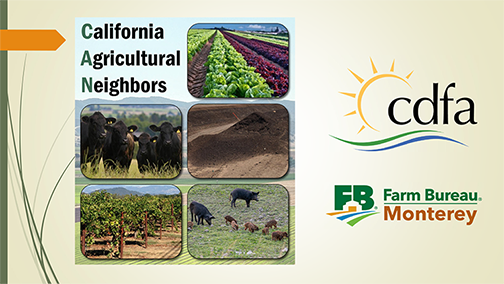
California Agricultural Neighbors (CAN) was established in 2021 in response to continued outbreaks of pathogenic Escherichia coli (E. coli) O157:H7 associated with leafy greens in the California coastal region. Visit CDFA’s Produce Safety One Health Initiatives webpage for more information.
As a collaboration with the California Department of Food and Agriculture and Monterey County Farm Bureau, California Agricultural Neighbors (CAN) continues to make progress on adjacent land interactions to better understand and manage potential risk intersections when produce growers, cattle ranchers, vineyard managers, compost processors and wildlife lands operate or co-exist as neighbors.
Significant progress has been made by all four work groups, as detailed in this summary update:
Work Group 1: Foster Neighbor-to-Neighbor Interactions and Conversations – A draft resource guide has been created for adjacent neighbors that outlines topics for discussion that improves mutual understanding of activities relevant to safe fresh food production. A pilot program is underway including direct interviews with neighbors to refine the discussion guide and to facilitate, encourage and support neighbor discussions in the Salinas Valley region.
Work Group 2: Build a Research Roadmap – A framework has been built around research gaps related to survival, persistence and amplification of Shiga toxin-producing E. coli (STEC) in the environment, along with mechanisms of movement and transport (air, water, animals, machinery). Prioritization of these research needs has been classified into high (likely to provide solutions), moderate (filling knowledge gaps) and low (unlikely to be defined or implemented).
Work Group 3: Create a Quantitative Microbial Risk Assessment Framework (QMRA) – Goals include: develop a skeleton framework for adjacent land operations (fresh food production fields, rangeland, vineyard and compost); build a list of presumptive mechanisms for transfer, persistence, survival and amplification of STEC factors with prioritization based on the research roadmap (filling in of information gaps); determine weather and abiotic conditions that may influence risk and survival. This is proving to be quite a complex set of values to be studied and delineated within the QMRA skeletal framework.
Work Group 4: Knowledge Transfer from Research to Practice – Completed one-on-one interviews with stakeholders to create summary of ideas for consideration, along with capacity building. A white paper will be published with actions and recommendations; a review of other successful programs will be integrated into how and when knowledge about food safety practices in adjacent lands can be promoted and implemented.
A possible separate work group is contemplated focusing on defining incentives for adoption of field and rangeland practices, drawing on the outcomes of Work Groups 3 and 4.
CAN continues to make progress in redefining how neighbor-to-neighbor interactions are key to food safety practices, with sensible approaches to real world solutions that can be implemented universally, and as a model for widespread adoption. CAN continues to leverage connections to avoid duplication of resources and research efforts, promoting a unified message about adjacent lands interactions. A more comprehensive update on these four key action areas is anticipated in fall 2024.
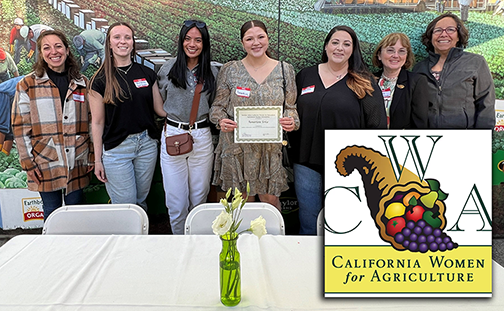
CDFA summer intern Tonantzin Ortiz (center) stands with board members of the Salinas Valley Chapter of California Women for Agriculture during a ceremony in which they presented her with an Agricultural Studies Scholarship.
The California Department of Food and Agriculture (CDFA) Inspection Services Division (ISD) welcomes summer intern Tonantzin Ortiz and congratulates her for recently earning a Salinas Valley Chapter of California Women in Agriculture (CWA) Agricultural Studies Scholarship.
“As part of CDFA’s Ag Vision to support workforce development aimed at attracting, supporting and providing high-quality jobs and leadership opportunities, we welcome Tonantzin with open arms to her summer internship,” ISD Director Natalie Krout-Greenberg said. “We also congratulate her for winning an honorable scholarship.”
Oritz attributes earning the scholarship to being an active member of both Salinas Valley and Central Valley CWA chapters, and volunteering at multiple elementary school events the past year to demonstrate the importance of the water cycle.
“I honestly can’t believe I won,” she said. “Growing up I was never the type of student to get recognition for my volunteer efforts and contributions to the community, so it definitely is a pat on the back for all the hard work I’ve done this year.”
A senior a California State University, Fresno, Ortiz is on track to her earn her bachelor’s degree in plant science this December. She plans on utilizing the scholarship funds to continue her education toward earning a master’s degree in breeding, environmental science or food safety. Her long-term aspirations include an agricultural career.
“Something that I hope to do after college is to become a staple within my community by promoting and allowing young individuals to see the multi-faced aspects of agriculture and inform them of the many opportunities there are within this industry and how much help there is for students,” Ortiz said. “The reasoning behind pursuing this as my goal is to promote young people of color like myself to become leaders and not just workers within the ag industry, and to make a positive impact on not just our communities, but our environment.”
Furthering her efforts toward a career in agriculture, Ortiz applied to the Maddy Institute’s Agricultural Policy Internship Program. The result is her current summer internship with ISD’s Produce Safety Program (PSP). Her internship duties include: Helping generate PSP’s farm inventory verification list for the upcoming fiscal year, researching information specific to growing practices for berries, performing farm verification phone calls, and learning about farmer education and regulatory functions by shadowing PSP inspectors during an On-Farm Readiness Review and farm inspection.
Ortiz also has some advice for people pursuing an agricultural career.
“I just want to say to all the students out there, don’t limit your potential and always strive for more, even though you think it’s out of your reach!”
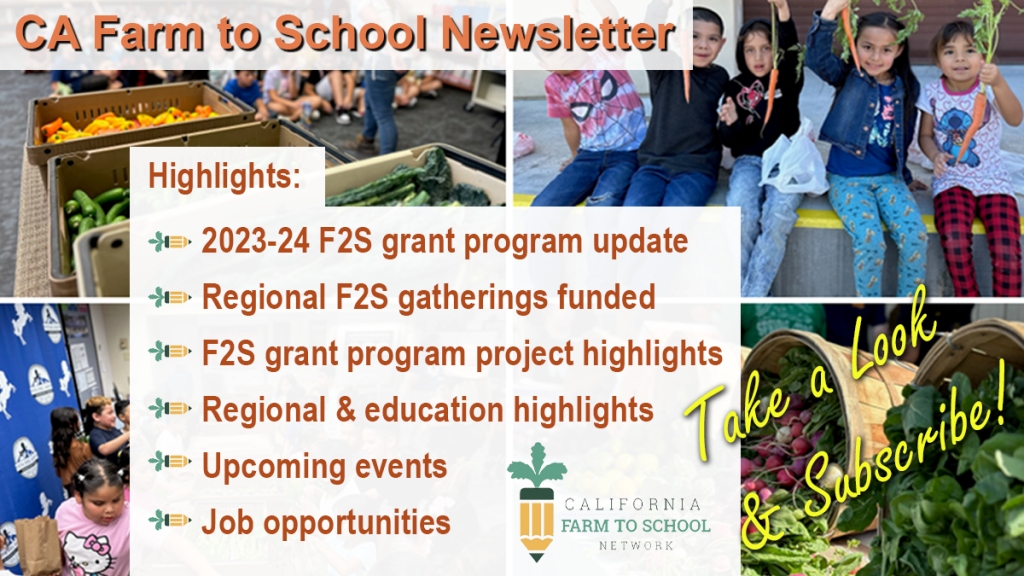
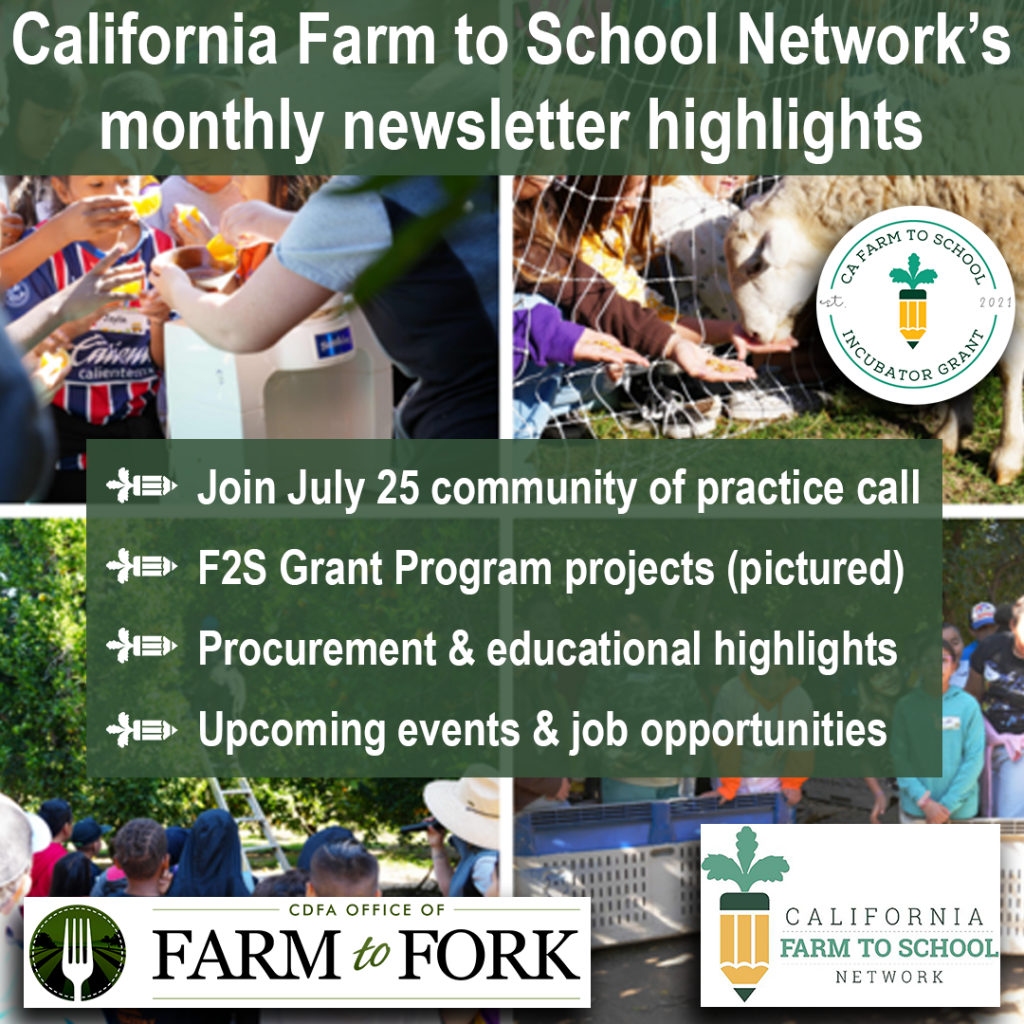
Click on the graphic above to view this June 2024 California Farm to School Network newsletter and subscribe to automatically receive future newsletters.
This is a blog for the California Department of Food and Agriculture (CDFA) Inspection Services Division (ISD). Read here for the latest news about how ISD is providing Californians professional services that support and contribute to a safe, abundant and quality food supply; environmentally sound agricultural practices; and an equitable marketplace for California agriculture.