

California leads the nation in data transparency through the collection and sharing of pesticide use data, providing stakeholders, state agencies, and the public with valuable insights into pest management throughout the state. The Pesticide Use Reporting (PUR) Database maintained by the California Department of Pesticide Regulation (DPR) serves as a resource for the public to track and understand how pesticide use has changed in California over the past decades. Every year, DPR releases their Pesticide Use Annual Report to highlight short-term and long-term pesticide use trends by commodity and categories of interest (e.g. biopesticides, carcinogens, toxic air contaminants) to inform actions to mitigate potential impacts to human health and the environment and to inform California’s transition to safer, more sustainable pest management.
California’s agricultural landscape is constantly evolving in response to the development of new technologies, novel pest threats, and the changing climate. Furthermore, the diversity of California’s specialty crops means different types of growers must use different pest management strategies to adapt to new conditions. To better understand what specific factors are driving changes in important categories of pesticide use, CDFA’s Office of Pesticide Consultation and Analysis (OPCA) has published a report on how individual crops and pesticide active ingredients contributed to changes in the use of pesticide categories of interest between 2022 and 2023.
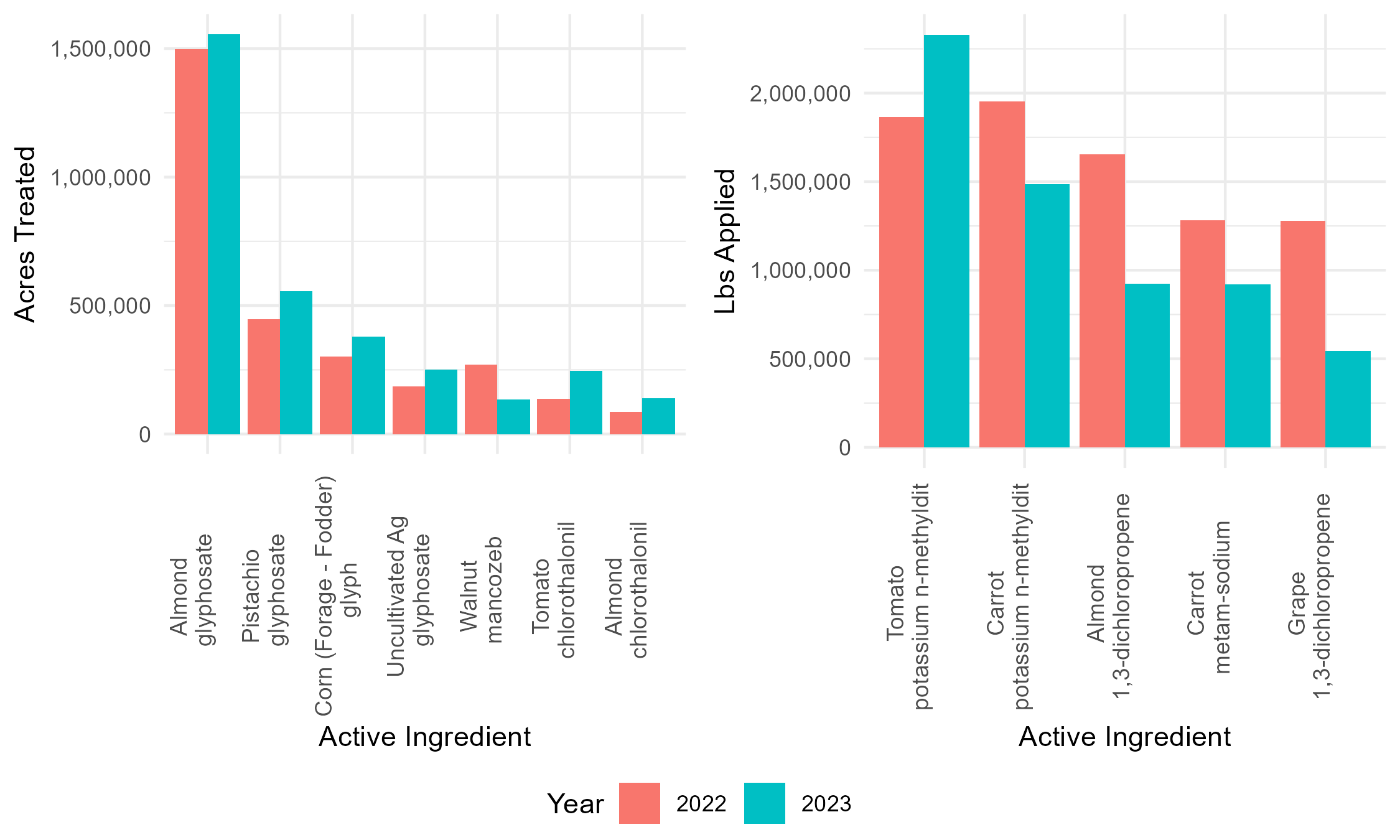
In many cases, the use of specific pesticide active ingredients increased in one crop while it decreased in another, highlighting the complexity behind total annual changes in pesticide use categories. For example, DPR’s Annual Report shows that the total pounds applied of pesticides classified as carcinogens decreased by 6% from 2022-2024, but the acres that received treatments of pesticides classified as carcinogens actually increased by 6% in the same period. OPCA’s report breaks down the specific uses of each pesticide in the carcinogen category to show that glyphosate use increased in almond, pistachio, and corn and drove up the number of acres treated, while fumigant use fell in carrots, grapes, and almonds, driving down pounds applied.
Changes in Use of Pesticides Classified as Carcinogens by crop from 2022-2023.
The OPCA report also shows that many changes in annual pesticide use are driven more by how many acres of a crop are grown that year rather than any changes in management practices by growers. While the use of the herbicide thiobencarb doubled in rice production between 2022 and 2023, California grew twice as many acres of rice in 2023 compared to 2022. This highlights the importance of looking at how individual crop systems change and how specific pesticide products are used in order to accurately interpret how pesticide use data reflects in-field conditions and to evaluate how state policies and programs are effectuating changes in pest management practices. The full report contains many actionable insights into pesticide use across categories and throughout the state.