Sign Up Today for Online Produce Safety Rule Grower Training Course

Have you completed your Produce Safety Rule Grower Training yet? If not, now is the time to sign up for an online course through the Produce Safety Alliance (PSA) Upcoming Grower Trainings website. Only offered in person before, this training is now offered online during the COVID-19 pandemic. 

As of January 2020, all produce farms generating more than $25,000 in average annual produce sales during the previous three-year period are required to comply with food safety regulations under the Produce Safety Rule of the federal Food Safety Modernization Act (FSMA). In California, these farms also are now subject to inspections conducted by the California Department of Food and Agriculture (CDFA) Produce Safety Program.

One of the first things a farm must do under this new regulation is have one employee complete a Produce Safety Rule Grower Training course. The course need only be taken once. The best way to locate and register for one of these training courses is to visit the Produce Safety Alliance (PSA) Upcoming Grower Trainings website

The PSA is a collaborative project between Cornell University, the U.S. Department of Agriculture and the Food and Drug Administration. The overarching objective of this project is to provide the produce industry and associated groups with training and educational opportunities related to current best practices, guidance and regulatory requirements.

The courses listed on this website are provided by various organizations throughout the country and presented so that farmers can sign up for one that meets their needs. Prior to the pandemic, this course was only offered in person and involved a seven- to eight-hour classroom style session. Now, most courses are offered remotely in two formats: 

Online Delivery – a three-week course that can be completed at your own pace and is expected to take 15 to 30 hours to complete.

Remote Delivery – led in real time by instructors delivered with video conferencing software such as Zoom or Webex.

CDFA’s Produce Safety Program encourages produce farms both large and small to complete this required course as soon as possible. The course content will provide information on how to comply with new food safety laws, prepare you for a Produce Safety Rule inspection and help ensure safe produce for consumers.

CDFA Welcomes Lina Nguyen: The Face of ‘Educate Then Regulate’

The California Department of Food and Agriculture (CDFA) is committed to educating California produce farmers on how to follow new food safety regulations of the Produce Safety Rule (PSR) under the federal Food Safety Modernization Act (FSMA).  

To strengthen this commitment, the CDFA Inspection and Compliance Branch recently brought on Lina Nguyen as a Senior Environmental Scientist Specialist. Lina is dedicated to making sure farmers understand how to comply with the PSR and can pass CDFA Produce Safety Program (PSP) inspections being conducted on their farms on behalf of the U.S. Food and Drug Administration.

Lina has been working with the PSP since November. Until the COVID-19 pandemic hit, her job was to visit produce farms immediately following a PSR inspection to make sure that all non-compliance issues were corrected and that the farm understood exactly what is required of them under the PSR.

“My job is much more about education and communication than enforcement,” Lina said. “We want farmers to understand and implement the required food safety practices on their farms and to know why these are important.”

Lina holds a degree in human biology from the University of California, Merced. Prior to joining CDFA, she held positions in quality assurance/quality control at farms and other food facilities. One of her first jobs was with a prune growing and processing operation in Yuba County where she implemented its initial hazard analysis and critical control points (HAACP) program and created systems for documentation even before FSMA came into law.

With experience in food production and regulatory requirements, Lina is perfect for the job of helping farmers understand how to comply with regulations. She also will be spearheading a collaboration with University of California (UC) Cooperative Extension to develop tools and other educational resources to support produce farms in following PSR regulations. Through this work with UC, she will help connect growers with expertise to aid in performing root cause analysis to advance food safety learnings and put preventive measures in place to help avoid future outbreaks.    

Lina noted that as she is able to spend more time with farmers and inspectors, she hopes they can zero in on the key areas where farmers need more assistance in terms of compliance. Then, farming personnel, food safety officials and UC staff can collaborate in creating further beneficial guidance for farmers in a number of food safety areas.

We look forward to learning more from Lina Nguyen.

Produce Safety Rule Grower Training Offered Remotely During Pandemic

Implementation of the Food Safety Modernization Act’s Produce Safety Rule (PSR) continues to roll out in California. Since January 26, 2018, produce farms designated as “large” (those with annual sales greater than $500,000) have been required to comply with the new federal regulations under the PSR. The next to be required to comply were farms with $250,000 or more in annual sales and starting in January of this year farms with $25,000 to $250,000 in annual sales also were required to comply.

One of the initial PSR requirements is that every produce farm must have an individual employed who has completed a Produce Safety Rule Grower Training, or equivalent course, approved by the U.S. Food and Drug Administration (FDA). FDA normally requires these courses to be attended in person, but for a limited time, a remote course has been approved as shelter-in-place orders continue throughout the country. If your farm has yet to have an employee complete this course, now is the perfect time to enroll. 

Two remote courses are scheduled for May, with one on May 14 and the other on May 28. Both are being offered through the Western Institute for Food Safety and Security (WIFSS) located at UC Davis. Each course includes 7 hours of instruction via Zoom. Attendees must have web-cam and audio capabilities and will be required to have both operating during the full course of the training from 8:00 a.m. to 5:00 p.m. to verify presence and participation. Zoom does not require special software. Attendees are also required to have a printed manual and one will be mailed to you prior to the course

Course instructors are David Goldenberg of WIFSS, Michele Jay-Russell of the Western Center for Food Safety and Donna Clements of the Produce Safety Alliance. Individuals who participate in these courses will gain a basic understanding of the following: microorganisms and where they may be found on the farm; how to identify microbial risks and the practices that reduce risks; how to write a farm food safety plan and requirements of the Produce Safety Rule and how to meet them.

Visit the WIFSS website to register.  May 7 is the registration deadline for the May 14 course.  May 21 is the registration deadline for the May 28 course. The cost is $60. After attending the course, participants will be eligible to receive a certificate from the Association of Food and Drug Officials that verifies they have completed the training course.

Produce Safety Program Supervisor Discusses Produce Safety Rule Impact on California Farmers in Radio Interview

CDFA Produce Safety Program Regulates the FDA Food Modernization Act

California Department of Food and Agriculture (CDFA) Produce Safety Program (PSP) Supervisor Shelley Phillips was recently interviewed by “Farmer Fred” Hoffman on KSTE radio’s “Farm Hour” program to discuss the impact of the federal Food Safety Modernization Act (FSMA) Produce Safety Rule (PSR) on California farmers.

CDFA created the PSP to “Educate then Regulate” California farmers about the PSR under the authority of the U.S. Food & Drug Administration (FDA), in partnership with the California Department of Public Health (CDPH). FSMA was passed in 2011 to help prevent foodborne illness outbreaks. PSR implementation and enforcement is occurring in stages between 2019 and 2021.

“It’s a way for the FDA to be proactive about food safety rather than being reactive when we have outbreaks or other issues surrounding food safety,” Phillips says about the PSR during the interview.

Items Phillips discusses during the 10-minute interview include:

  • Which farms are required to verify PSR compliance and which farms are PSR exempt
  • What proactive measures farmers are required to follow under the PSR
  • The current stage of PSR implementation and inspections
  • How “small” farmers (average annual sales of $250,000–$500,000 during the previous three-year period) should fill out and submit a recent questionnaire that the CDFA mailed, in order to be prepared for the next stage of PSR inspections
  • What farmers should expect during all stages of a PSP inspection, from initial contact to a follow-up inspection report
  • The educational resources available on www.cdfa.ca.gov/producesafety to help farmers understand and prepare for PSR compliance, including scheduling an On-Farm Readiness Review

“The inspector is there to assist the farmer, so any questions that the farmer may have is fair game,” Phillips says at the interview’s conclusion. 

Click here to hear the full interview.

PRODUCE SAFETY RULE UPDATE – CDFA MAILS QUESTIONNAIRES TO SMALLER PRODUCE FARMS

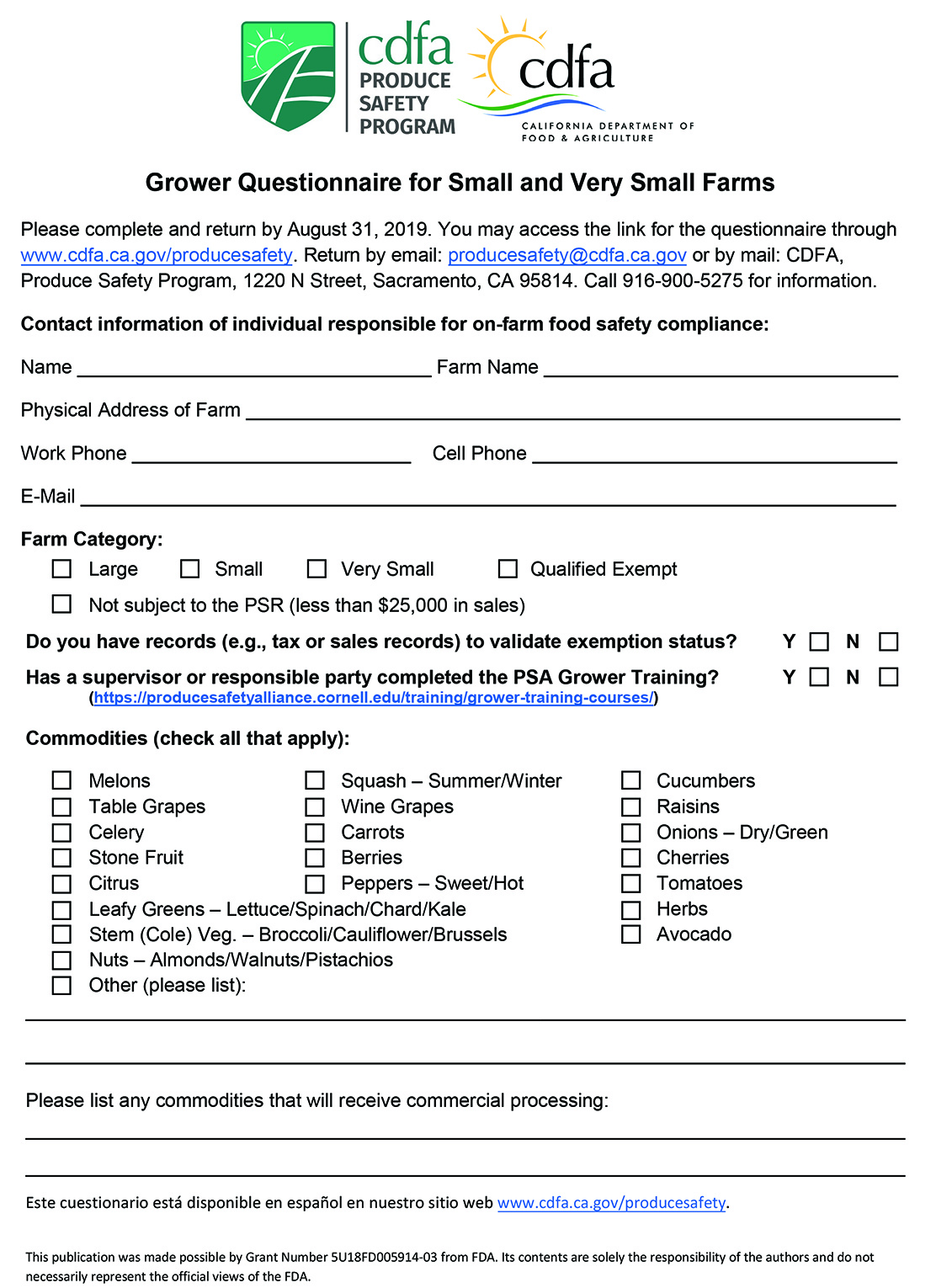
Small and Very Small Produce Farmer Questionnaire

SACRAMENTO, July 25, 2019 – The California Department of Food and Agriculture (CDFA) is announcing that starting next week, 8,000 “small” and “very small” produce farms throughout California are being mailed educational letters about their roles in upholding the Produce Safety Rule (PSR) of the federal Food Safety Modernization Act (FSMA), passed in 2011 to help prevent foodborne illness outbreaks. Accompanying the letters are questionnaires to be returned to the CDFA by August 31 in order to verify commodities grown, determine whether annual sales qualify farms for a PSR exemption, and to help prioritize future inspections. The current stage of inspections to verify PSR compliance has been taking place since April for “large” farms.

“California has many more produce farms than any other state in the nation,” said CDFA Secretary Karen Ross. “Approximately 20,000 farms in the Golden State will now be subject to new food safety regulations under the Produce Safety Rule.”

PSR regulations include ensuring produce is properly handled by workers, that farm equipment is sanitary, that produce is grown with safe soil inputs, and that measures are in place to prevent contamination of produce by wildlife or domesticated animals. These regulations are similar to food safety plans that many farmers have been implementing for years, and that most grocery stores and restaurants already require. However, the Produce Safety Rule now makes food safety on farms federal law.

To help implement the PSR, CDFA created the Produce Safety Program (PSP) to educate farmers and then conduct on-farm inspections on behalf of the U.S. Food and Drug Administration (FDA). PSP farmer education resources include a website, a Facebook page and an e-newsletter. Website features include the ability to schedule an On-Farm Readiness Review, and to register for a Produce Safety Rule Grower Training Course. This course is mandatory for at least one employee of every produce farm covered under the new regulations and is the best way for farmers to learn about required food safety practices.

In the current PSR stage:

  • Inspections are underway for “large” produce farms with average annual sales of $500,000 or greater during the previous three-year period.
  • “Small” farms with average annual sales of $250,000–$500,000 during the previous three-year period are now expected to be in PSR compliance, with inspections set to begin in January 2020.
  • “Very small” farms with average annual sales of $25,000–$250,000 during the previous three-year period must be in general compliance by January 2020, with inspections set to begin in January 2021.

Any farm that does not comply with the Produce Safety Rule may face economic, regulatory and legal consequences. Minor violations will be handled through on-site education, in line with an “Educate Then Regulate” commitment. However, if there is significant and imminent threat to public health, a PSP inspector will inform the FDA and the California Department of Public Health, which may perform accelerated on-farm follow-up inspections or administrative detention orders up to and including seizure of the product that could cause people to get sick.
 
Visit www.cdfa.ca.gov/producesafety

CDFA TO HOLD ‘GOOD AG NEIGHBOR’ WORKSHOPS FOR PRODUCE AND LIVESTOCK OPERATIONS

In order to facilitate dialogue between different sectors of California agriculture about cooperation to prevent future foodborne illness outbreaks, the California Department of Food and Agriculture (CDFA) is partnering with the University of California and the U.S. Food and Drug Administration (FDA) to bring the livestock and produce communities together for a series of workshops.

The workshops, titled Good Ag Neighbors are designed for fruit and vegetable growers, livestock owners, and others interested in learning about how produce safety and livestock management practices can work jointly to promote food safety.

They will be held in two California locations, with the first scheduled for June 11 from 9 a.m. to 4 p.m. at the Desert Research and Extension Center in Holtville. The second workshop is scheduled for June 13 from 9 a.m. to 4 p.m. at the Robert J Cabral Ag Center in Stockton.

In announcing these workshop, CDFA Secretary Karen Ross noted that agriculture is complex, particularly in California where diverse agricultural operations often exist side-by-side with each of them required to comply with a myriad of regulations designed to protect the public, the environment and the food supply.

She emphasized that open communication channels between diverse partners is important. This has become more apparent with the CDFA’s newly created Produce Safety Program, which is working on behalf of the U.S. FDA to enforce produce safety regulations under the Food Safety Modernization Act.

The workshops are being conducted by the UC Davis Western Institute for Food Safety and Security and will include presentations by researchers and industry representatives. The day-long agenda will focus in the morning on reviewing regulations, laws and practices already in place to protect food and environmental safety, while the afternoon will be spent in various breakout groups examining how these practices can be leveraged.

The sessions will address lessons learned from recent investigations of produce-related foodborne illness outbreaks, examine key research findings, and consider future research needs.

Participants should come prepared to share their experiences as well as their produce safety questions.

The workshops are offered free of charge. For more information and to register, please visit http://www.wifss.ucdavis.edu/good-ag-neighbors/