CDFA Produce Safety Program to Host PSP Portal Training Workshops

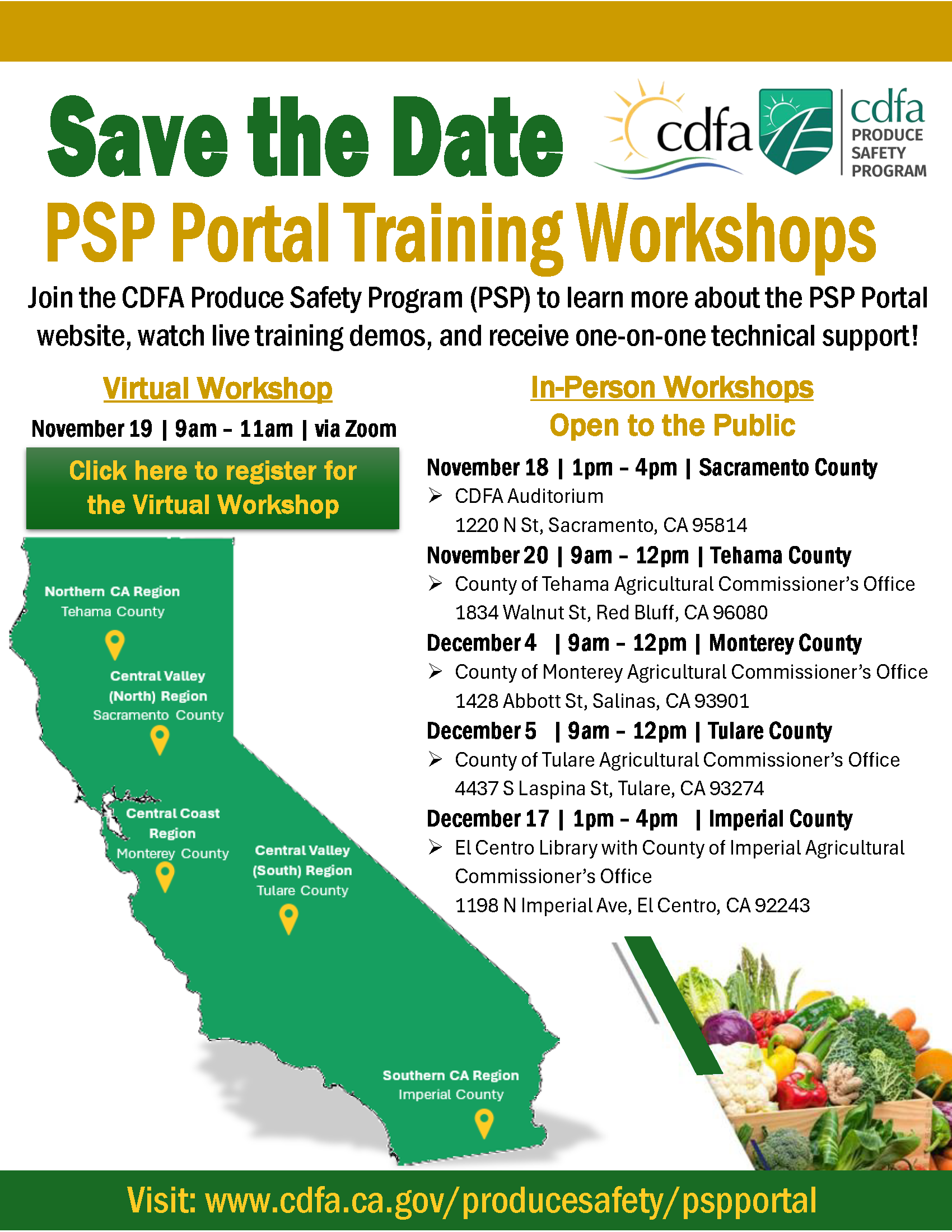
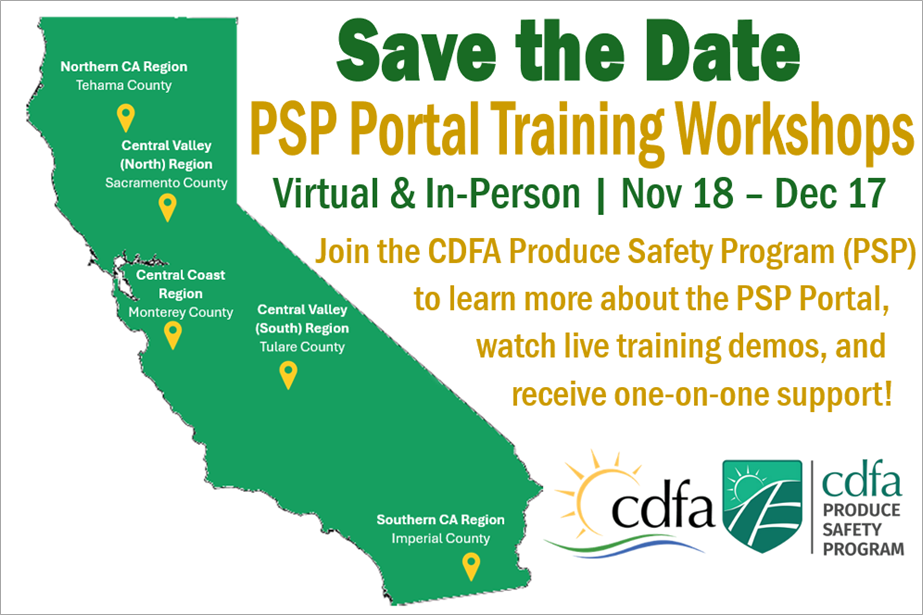
The California Department of Food and Agriculture (CDFA) Produce Safety Program (PSP) will host a series of PSP Portal Training Workshops during November and December. Five in-person workshops will be held across the State of California between November 18 – December 17, 2024. A virtual workshop will be held on November 19, 2024.

Workshops will include a presentation that provides an overview of the CDFA Produce Safety Program, PSP Portal, and live training tutorials on how to navigate the website. All in-person workshops will have the first hour reserved for the training presentation and the remaining time dedicated for attendees that wish to receive one-on-one technical support with the PSP Portal. The virtual webinar will have the first hour reserved for the training presentation followed by a Q&A session.

Virtual Workshop | Click here to register!

November 19 | 9am – 11am | via Zoom

In-Person Workshops | Open to the Public

November 18 | 1pm – 4pm | Sacramento County

  • CDFA Auditorium: 1220 N St, Sacramento, CA 95814

November 20 | 9am – 12pm | Tehama County

  • County of Tehama Agricultural Commissioner’s Office: 1834 Walnut St, Red Bluff, CA 96080

December 4 | 9am – 12pm | Monterey County

  • County of Monterey Agricultural Commissioner’s Office: 1428 Abbott St, Salinas, CA 93901

December 5 | 9am – 12pm | Tulare County

  • County of Tulare Agricultural Commissioner’s Office: 4437 S Laspina St, Tulare, CA 93274

December 17 | 1pm – 4pm | Imperial County

  • El Centro Library with County of Imperial Agricultural Commissioner’s Office: 1198 N Imperial Ave, El Centro, CA 92243

What is the PSP Portal? The PSP Portal is a cloud-based farm data repository platform that allows California produce farmers and growers to view their own farm information and have on-demand access to their digital produce safety inspection reports related to their own farms. In addition, the PSP Portal will provide resources to support on-farm compliance with the requirements of the federal Food Safety Modernization Act (FSMA) Produce Safety Rule and provide a convenient way for California growers to connect with PSP staff. The new technology will also allow the Produce Safety Program to focus inspection efforts based on food safety risk factors to help ensure a safe and quality food supply for all consumers of California fresh produce in the state, nationally and beyond.

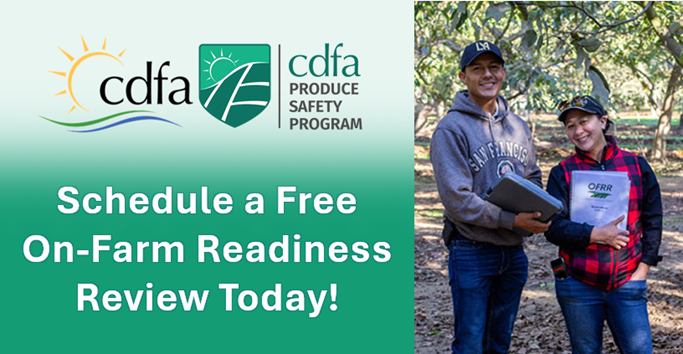
Schedule a Free On-Farm Readiness Review Today!

Are you prepared for your produce safety regulatory inspection? Are you wondering how the requirements of the Food Safety Modernization Act (FSMA) Produce Safety Rule (PSR) apply to your farm and food safety practices?

Get answers to these questions and more by scheduling a free On-Farm Readiness Review!

Produce farms nationwide that are covered under the federal FSMA Produce Safety Rule are required to comply with the requirements of the Produce Safety Rule and are subject to mandatory regulatory inspections as required by the U.S. Food and Drug Administration (FDA) under the jurisdiction of the Federal Food, Drug, and Cosmetic Act. In California, the California Department of Food and Agriculture (CDFA) Produce Safety Program (PSP) inspectors are duly appointed officers authorized to conduct on-farm produce safety regulatory inspections on behalf of the FDA.

To prepare for a produce safety inspection, California farm operators are encouraged to request an On-Farm Readiness Review (OFRR). An OFRR is a free, voluntary, customized assessment conducted before an initial regulatory inspection. An OFRR includes a farm walk-around and one-on-one conversations with CDFA PSP staff to discuss how the Produce Safety Rule applies to your operation.

An OFRR is not a regulatory inspection. Instead, it aims to help prepare you for your upcoming produce safety inspection and discuss enhanced food safety practices tailored to your unique farm needs. Farms that request an OFRR will receive a free OFRR produce safety manual, FSMA Produce Safety Rule regulatory pocket handbook, and recordkeeping templates. “Small”[1] and “Very Small”[2] farms that have not yet undergone an initial FSMA Produce Safety Rule regulatory inspection can especially benefit from an OFRR to aid in their preparation plan for their subsequent initial inspection.

In California, farm operators are encouraged to request a free OFRR assessment after completing the Produce Safety Alliance (PSA) Grower Training Course. Scheduling an OFRR is easy! Simply email producesafety@cdfa.ca.gov or call our Produce Safety Rule and Outreach Specialist, Angela Terrazas, at 916-809-0245. When requesting an OFRR, please be prepared to provide the following information to support a seamless scheduling process:

  1. Farm name and location
  2. A contact person and how to contact you
  3. What produce do you grow, harvest, pack, or hold?
  4. When are you harvesting?
  5. Have you completed the PSA Grower Training?

Questions? Please contact producesafety@cdfa.ca.gov or Angela Terrazas at 916-809-0245.

The CDFA Produce Safety Program is a unit operating under the CDFA Inspection Services Division with a mission to ensure California produce farmers understand how to comply with the requirements of the FSMA Produce Safety Rule, resulting in a safer food supply for the people of California and beyond.

Under the FSMA Produce Safety Rule, farms sizes are classified by the average annual gross produce sales adjusted for inflation over a three-year period. Click here to learn more about the FSMA Inflation Adjusted Cut Offs. “Large” farms have average annual produce sales above $500,000 adjusted for inflation.

[1] “Small” farms have average annual produce sales above $250,000 and up to $500,000 adjusted for inflation.

[2] “Very Small” farms have average annual produce sales above $25,000 and up to $250,000 adjusted for inflation.

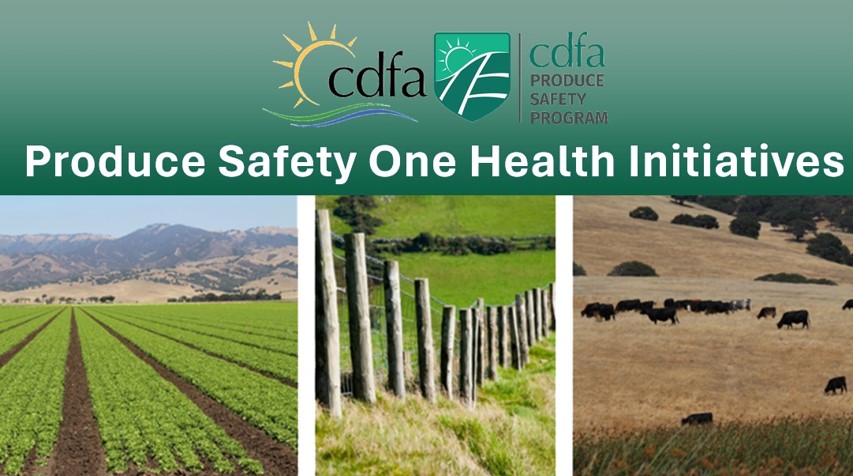
CDFA Launches Produce Safety One Health Initiatives Webpage

The California Department of Food and Agriculture (CDFA) Produce Safety Program (PSP) announces the launch of a Produce Safety One Health Initiatives webpage dedicated to California’s actions for enhanced produce safety based on the One Health approach.

In response to a series of E. coli O157:H7 outbreaks associated with leafy greens between 2018 to 2020, CDFA launched the California Longitudinal Study (CALS) in 2020 and California Agricultural Neighbors (CAN) in 2021. These actions are part of a collaborative effort across government agencies (federal, state, and local), universities, industry associations, and members of the produce, viticulture, livestock, and compost industries to initiate dialogues, address knowledge gaps, and foster enhanced produce safety practices.

The research efforts taking place in California are based on the globally supported One Health approach, a multidisciplinary systems-thinking approach that recognizes the health of people is interconnected to the health of animals, plants, and our shared environments. The One Health approach is a fundamental component of the national Healthy People initiative, released every decade since 1990 by the U.S. Department of Health and Human Services (HHS), which guides health promotion and disease prevention efforts to improve the health of the nation.

The California Longitudinal Study (CALS) is a multi-year study launched in 2020 targeted towards adaptively identifying environmental factors affecting foodborne pathogens to address knowledge gaps and assist in solutions-oriented outcomes for growers and affiliates in the agriculture industry. To accomplish this, California’s leafy green industry is collaborating with state and federal agencies, the UC Davis Western Center for Food Safety, and partners across California’s cattle, viticulture, and compost industries.

California Agricultural Neighbors (CAN) is a collaborative effort led by CDFA and the Monterey County Farm Bureau (MCFB) launched in 2021 that provides a roundtable forum to foster dialogue and neighborly practices for enhanced food safety when agriculture operations are adjacent to one another. CAN efforts are supported by the California Farm Bureau FederationCalifornia Cattlemen’s AssociationWestern Growers Association, and the California Leafy Greens Marketing Agreement to help with facilitation services provided by Abby Dilley, RESOLVE. The full 2022 CAN Report is available for review here.  

To learn more about California’s Produce Safety One Health Initiatives, please visit https://www.cdfa.ca.gov/producesafety/onehealthinitiatives/.

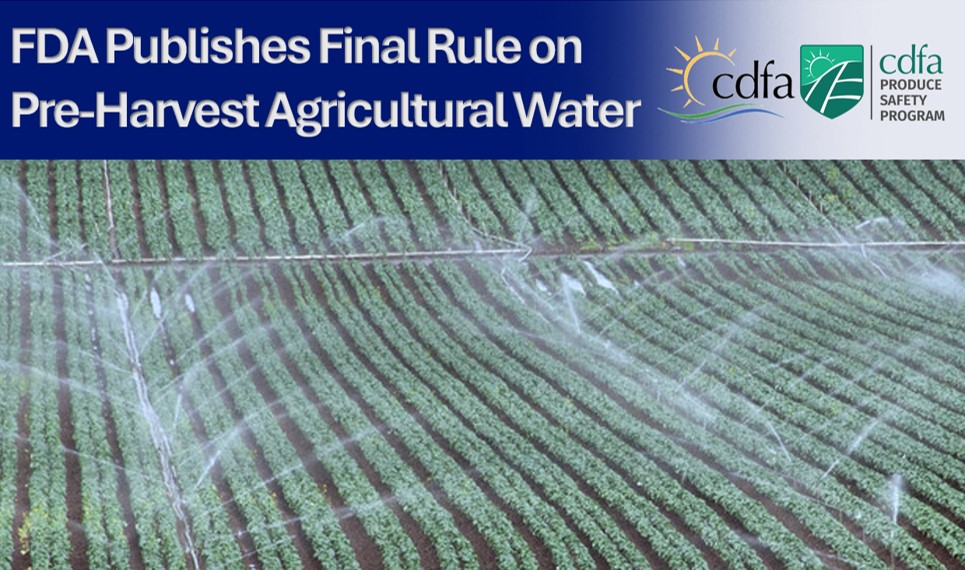
FDA Publishes Final Rule on Pre-Harvest Agricultural Water

On May 6, 2024, the U.S. Food and Drug Administration (FDA) published a final rule on pre-harvest agricultural water revising certain requirements in Subpart E of the FSMA Produce Safety Rule (PSR) for covered produce (other than sprouts) for enhanced produce safety.

The new rule replaces the prior pre-harvest water microbial quality criteria and testing requirements with requirements for systems-based agricultural water assessments for hazard identification and risk management. Agricultural water assessments will now need to be conducted once annually, and whenever a significant change occurs that increases the likelihood of hazards being introduced to produce or food contact surfaces. The new rule does not change existing agricultural water requirements for sprouts or harvest and post-harvest water uses.

FDA states this new rule:

  • Establishes requirements for agricultural water assessments that evaluate a variety of factors that are key determinants of contamination risks associated with pre-harvest agricultural water. This includes an evaluation of the water system, water use practices, crop characteristics, environmental conditions, potential impacts on water from adjacent and nearby land, and other relevant factors.
  • Includes testing pre-harvest agricultural water as part of an assessment in certain circumstances.
  • Requires farms to implement effective mitigation measures within specific timeframes based on findings from their assessments. Hazards related to certain activities associated with adjacent and nearby land uses are subject to expedited mitigation.
  • Adds new options for mitigation measures, providing farms with additional flexibility in responding to findings from their pre-harvest agricultural water assessments.

The final rule is effective July 5, 2024. Compliance dates for the pre-harvest agricultural water requirements for covered produce (other than sprouts) are as follows[1]:

  • For Large farms: April 7, 2025 (9 months after the effective date of the final rule)
  • For Small farms: April 6, 2026 (1 year, 9 months after the effective date of the final rule)
  • For Very Small farms: April 5, 2027 (2 years, 9 months after the effective date of the final rule)

If you have questions about the Produce Safety Rule, please contact producesafety@cdfa.ca.gov.

Additional Resources:

[1] Under the FSMA Produce Safety Rule, farms sizes are classified by the average annual gross produce sales adjusted for inflation over a 3-year period. Click here to learn more about the FSMA Inflation Adjusted Cut Offs. “Large” farms have average annual produce sales above $500,000 adjusted for inflation. “Small” farms have average annual produce sales above $250,000 and up to $500,000 adjusted for inflation. “Very Small” farms have average annual produce sales above $25,000 and up to $250,000 adjusted for inflation.

Produce Safety Program Offers Flooding Response Resources for California Produce Growers

The California Department of Food and Agriculture (CDFA) Produce Safety Program announces a new Flooding Response Resources section has been added to its PSP Educate webpage.

As seasonal storms are underway, this new section offers several educational resources related to flooding and produce safety on farms. The California agricultural community is encouraged to visit this site regularly as new resources become available.

In Guidance for Industry: Evaluating the Safety of Flood-affected Food Crops for Human Consumption, the U.S. Food and Drug Administration (FDA) defines flooding in the context of produce safety as the flowing or overflowing of water from sources outside a farmer’s control onto lands used to grow, harvest, pack, or hold produce. Flooding events can pose a public health risk as flood waters may contain sewage, chemicals, heavy metals, pathogenic microorganisms, and other contaminants.

If the edible portion of a crop is exposed to floodwaters, it is considered adulterated under section 402(a)(4) (21 U.S.C. 342(a)(4)) of the Federal Food, Drug, and Cosmetic Act and should not enter human food channels. For crops that were in or near flooded areas but whose edible portion did NOT contact flood waters, growers should evaluate the safety of the crops for human consumption on a case-by-case basis for possible adulteration.

If you are impacted by flooding or would like to receive more information on how to respond to flooding with regards to produce safety, please reach out to us at producesafety@cdfa.ca.gov. The CDFA Produce Safety Program can provide technical assistance to California produce growers and can help connect you with experts through the CDFA Technical Assistance Program.

How California produce farmers can prepare for Produce Safety Rule inspection

Image of Sarah Standiford with the words "Interview with Produce Safety Program inspector gives tips on how to prepare for Produce Safety Rule inspection," with reference to the interview linked in the article and the CDFA Produce Safety Program logo

The Community Alliance with Family Farmers (CAFF) has published an interview with Sarah Standiford of CDFA’s Produce Safety Program as part of a Food Safety Modernization Act (FSMA) case study series. The interview highlights how California farms can prepare for a FSMA Produce Safety Rule inspection.

The article’s Q&A format reviews the background of why CDFA performs these inspections on behalf of the U.S. Food and Drug Administration, the steps that occur during an inspection, and tips for farmers preparing for an inspection.

“CDFA really values ‘soft skills’ in their inspectors and we understand that growers’ farms are their livelihoods,” Standiford says in the interview. “CDFA’s Produce Safety Program is here to help farms feel comfortable with the FSMA produce safety requirements and to foster compliance with the Produce Safety Rule. It’s a shared responsibility between growers, inspectors and farm employees – we all need to work together to keep our food safe.”

Click here to read the CAFF interview, “FSMA Inspection Case Study: CDFA FMSA PSP Inspector.” 

Click here to view this original post on CDFA’s Planting Seeds blog.