

Supporting International Information Exchange for Crop Production
OARS’ Environmental Scientist, Dr. Bagher Yousefi, recently joined the cohort for the 2026 Advanced School on Microirrigation for Crop Production. Dr. Daniele Zaccaria, professor of agricultural water management for Cooperative Extension at University of California, Davis, organized a 5-day classroom and field course.
A multidisciplinary team of UC ANR academics and international water scientists developed the Advanced School on Microirrigation for Crop Production. A multidisciplinary team designed the course to address one of the most pressing challenges in California agriculture: improving water management and efficiency while maintaining crop productivity and economic viability. This program translates current research into practical, field‑based knowledge that supports resource conservation, agricultural resilience, and informed decision‑making among water‑management professionals.
“California has long been a global leader in agricultural innovation, and we believe that advancing irrigation requires continuous learning and strong international partnerships,” said Dr. Daniele Zaccaria, Professor and Agricultural Water Management Specialist in Cooperative Extension at the University of California, Davis. “Through the Advanced Microirrigation School, we are creating opportunities for researchers, growers, irrigation professionals, and water managers to learn from one another, share practical solutions, and accelerate the adoption of technologies and management practices that improve water productivity, strengthen agricultural resilience, and support sustainable food production in California and around the world.”
Microirrigation, a climate-smart agriculture practice, continues to expand in California. According to Department of Water Resources’ Survey of Irrigation Methods, in 2021 53% of crops were irrigated using low-volume methods (i.e. surface drip, sub-surface drip, micro/mini-sprinklers). That compares to 15% in 1991, 33% in 2001, and 50% in 2016. Microirrigation is one of the most popular irrigation efficiency strategies funded through OARS’ State Water Efficiency and Enhancement Program (SWEEP). When microirrigation systems are designed, properly operated, and adequately maintained they allow producers to improve irrigation water use efficiency and experience other benefits, such as precise fertilizer applications and nutrient use efficiency.
For Dr. Yousefi, who holds a PhD in Irrigation and Drainage Engineering, the course offered an opportunity to network with irrigation experts and practitioners in California and learn more about microirrigation applications in California’s diverse growing regions. He participated in a three‑day theoretical course at UC Davis followed by a two‑day field trip across several agricultural regions in California. As a new employee, this training was essential for expanding his understanding of California agriculture and the advanced irrigation technologies that producers are implementing on farms.
The course covered a full range of topics, beginning with fundamental design and operational principles, and progressing to advanced crop water management concepts. Key topics included soil–water–crop relationships, weather and energy considerations, irrigation scheduling, filtration and fertigation systems, microirrigation automation, monitoring technologies, and crop‑specific irrigation strategies. Experienced professionals with extensive expertise in their respective areas taught each module. This provided an excellent opportunity to review core concepts and to learn about the latest instruments, strategies, and management techniques used in modern microirrigation systems.
During the field trip, Bagher observed modernized irrigation water delivery systems and gained practical exposure to orchard and vegetable operations, including walnuts, almonds, pistachio, grapes, and other specialty crops. These visits highlighted real California irrigation challenges and demonstrated how different technologies are applied in active production systems. He engaged with several California‑based experts and learned more about the integration of emerging technologies in on‑farm water management. Additionally, because the training was an international event, he was also able to build professional connections with participants from other countries and exchange technical knowledge.
Following this advanced training, Bagher identified several opportunities to enhance the SWEEP program tools and metrics. For example, subsurface irrigation and microjet sprinklers currently display similar efficiency values in the SWEEP Project Assessment Tool, despite differing field performance. He also noted that automation can significantly improve water‑use efficiency, but this benefit is not fully reflected in the program’s current modeling. These insights may support future updates to SWEEP to better capture water- and energy‑saving potential.
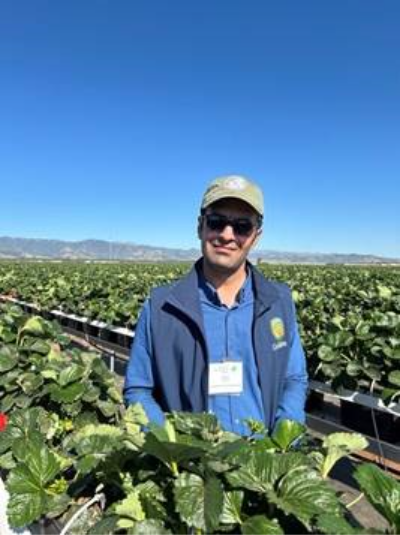
Bagher Yousefi observing microirrigation in tabletop grown strawberries.
“One of the most valuable aspects of this course was seeing how microirrigation technologies are adapted to address specific production challenges across California. For example, during a tabletop strawberry field visit, I observed how advanced microirrigation and monitoring systems are being used to improve water use efficiency and productivity and support high-value crop production. The experience reinforced a mindset that is essential in agriculture and water management: when challenges arise, we must find solutions or create them.” Bagher reflected, “This experience helped me connect modern microirrigation practices with real opportunities to improve and expand water savings through the SWEEP program.”
OARS congratulates the organizers on the successful launch of the Advanced Microirrigation School for Crop Production in California. One hundred and seven agricultural professionals joined the program in-person and an additional 18 participated online.
Building on the success of the 2026 Advanced Microirrigation School, the UC Cooperative Extension team is expanding its international educational and collaborative efforts. In partnership with the Chilean Water Innovation Technology Consortium and other international organizations, the University of California will co-organize an Advanced Microirrigation School in Chile in late 2027. The program will bring together irrigation professionals, researchers, engineers, consultants, growers, and water managers from California, Chile, Argentina, Brazil, Uruguay, Peru, Bolivia, and Costa Rica to exchange knowledge and practical experience on the latest advances in microirrigation system design, operation, management, performance evaluation, and emerging technologies.
As California continues to face increasing water resource challenges, programs such as these will play an important role in developing the technical expertise, partnerships, and innovative approaches needed to support a more efficient, resilient, and sustainable agricultural future.