


Note: This is part of a Research Update series that highlights projects funded by the California Department of Food and Agriculture Fertilizer Research and Education Program (FREP) .
Project Title: Nitrogen Response of Industrial Hemp Cultivars Grown for CBD, Essential Oils
Project Lead: Robert B. Hutmacher, UC Davis
Project Status: Complete (Three-year project)
Project location: Davis and Five Points, CA
Overview: This FREP-funded project evaluated the impact of nitrogen (N) fertilizer application rates on yield, N uptake, and concentrations of Cannabidiol (CBD) and Tetrahydrocannabinol (THC) in industrial hemp cultivars. This post focuses specifically on the yield and N uptake data.
Highlights
- Peak cola (flower bud) yields were obtained with 50-70 pounds of N fertilizer per acre (lbs N/ac) in autoflower (AF) hemp cultivars and with 100-140 lbs N/ac in full-season photoperiod sensitive (PPS) hemp cultivars
- In AF cultivars, N removal with harvest ranged from 60 to 75 lbs N/acre
- In PPS cultivars, N removal with harvest ranged from 75 to 100 lbs N/acre
- THC and CBD levels were not observed to be influenced by N application rates (data not shown in this post)
Background
Hemp, or industrial hemp, is comprised of cultivars in the botanical class of Cannabis sativa that are grown specifically for industrial and consumable use. Until recently, most research on Cannabis has been conducted with cultivars grown mainly for biomass, fiber, and grain rather than with cultivars targeted for production of CBD and related compounds, with research in California being particularly limited. Early market interest focused on production of CBD, so this study was initiated to develop an improved understanding of N fertilizer needs for optimal yield production of flowers and harvested materials for CBD, and the impacts of plant N status on CBD and THC concentrations in harvested plant tissue.
Approach
Field trials on industrial hemp cultivars were conducted in Davis at the UC Davis farm, (UCD) and Five PointsUC West Side Research and Extension Center (WSREC) in 2021 and 2022. Two representative cultivars were chosen for each growth habit type: 1) full season, photoperiod sensitive (PPS), harvested 120-130 days after planting, and 2) shorter-season photoperiod insensitive types/autoflower (AF), harvested 80 days post planting. Pre-plant irrigation was provided for establishment of transplants or seeds using surface line sprinklers (at WSREC) or surface drip (at UCD) and then transitioned to subsurface drip irrigation for in-season irrigations.
Five fertilizer rates were used, with N rates for AF cultivars ranging from 20-30 to 120 lbs N/ac versus 20 to 200 lbs N/ac in PPS cultivars. Nitrogen application amounts for AF and PPS cultivars are shown in Tables 1 and 2, respectively.
Table 1. Nitrogen fertilizer treatments used for Autoflower (AF) cultivars at UC Davis site (UCD) and West Side Research and Extension Center (WSREC).
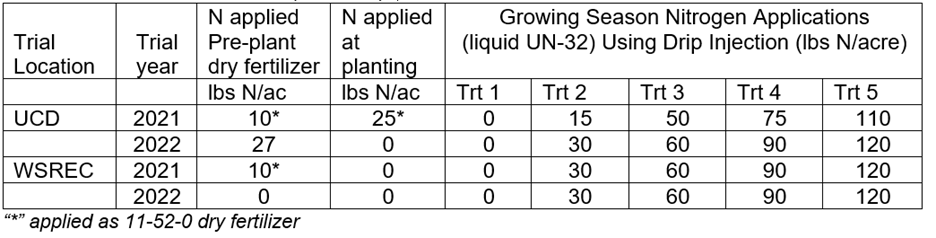
Table 2. Nitrogen fertilizer treatments used for Full-Season (PPS) cultivars at UC Davis site (UCD) and West Side Research and Extension Center (WSREC).
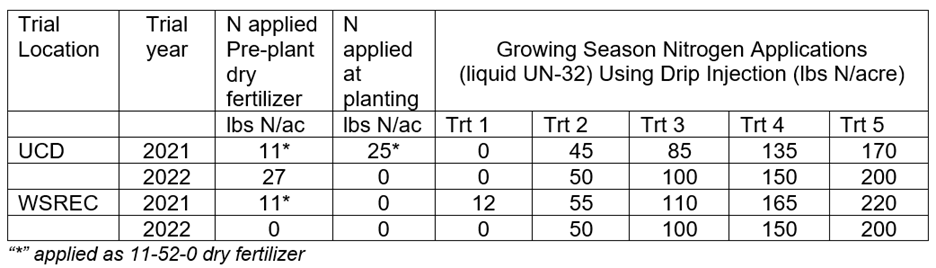
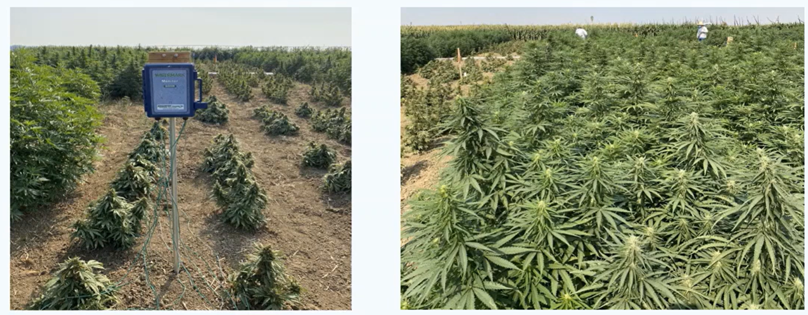
Industrial hemp full season varieties in N management trial at the WSREC site.
Findings
Cola yield
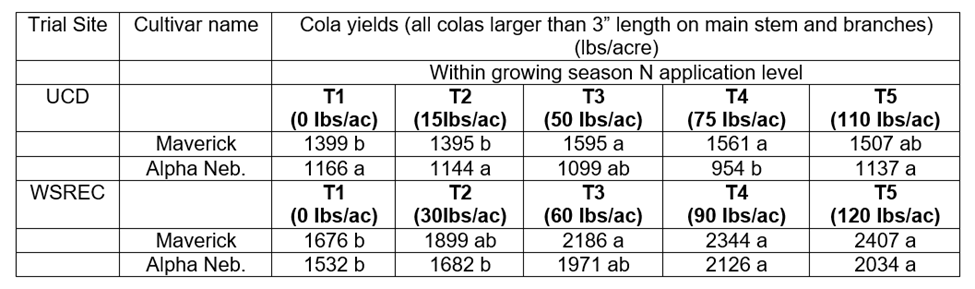
In 2021, cola (flower bud) yields in AF cultivars were more responsive to increasing N rates at WSREC than at the UCD site (Table 3), with large increases in cola yields at WSREC going from T1 to T3. There was less response with increasing N beyond the 60 or 90 lbs N/acre rate.
Table 3. Cola (flower bud) yields (in lbs/acre) as a function of applied nitrogen treatments for AF cultivars in 2021 at UCD and WSREC sites. Mean separation analyses were conducted for each site and cultivar type. Different letters indicate differences at the 5% probability level.
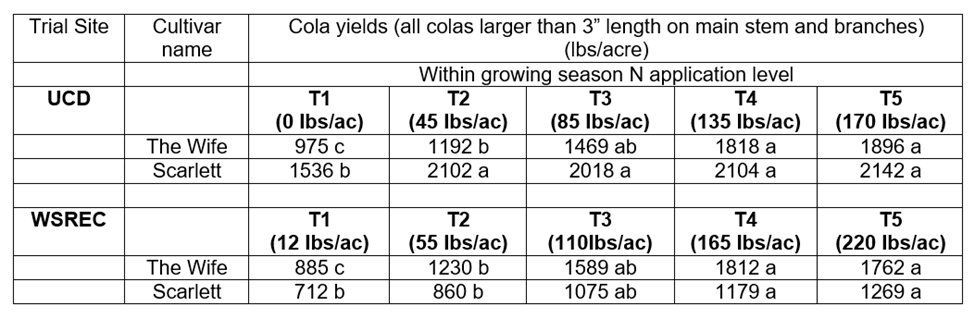
In PPS cultivars in 2021, at both sites and with both cultivars, there was a cola yield response to increasing N rate from the T1 to T3 (more consistent across sites than observed with AF types), with a more variable yield response to increases in rates with T4 and T5 treatments (Table 4).
Table 4. 2021 Cola (flower bud) yields (in lbs/acre) as a function of applied nitrogen treatments for PPS cultivars in 2021 at UCD and WSREC sites. Mean separation analyses were done by site and cultivar type. Different letters indicate differences at the 5% probability level.
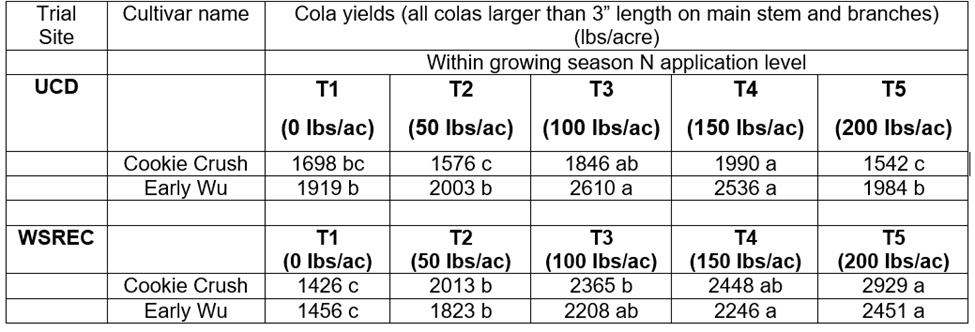
In 2022, plants at the WSREC had significant increases in cola yields up to T3 (100 lbs) and T4 (150 lbs) range of N application rate (Table 5). In most cases, cola yields did not increase with increases in N rates beyond 110 lbs N/acre (2021) or 100 lbs N/acre rate (2022).
Table 5. 2022 Cola yields (in lbs/acre) as a function of applied nitrogen treatments for PPS cultivars in 2022 at UCD and WSREC sites. Mean separation analyses were done by site and cultivar type, different letters indicating differences at 5% probability level.
As expected, crop above-ground total biomass (data not shown in this post) generally continued to increase with increasing applied N up through the T4 and T5 N application levels.
Nitrogen uptake
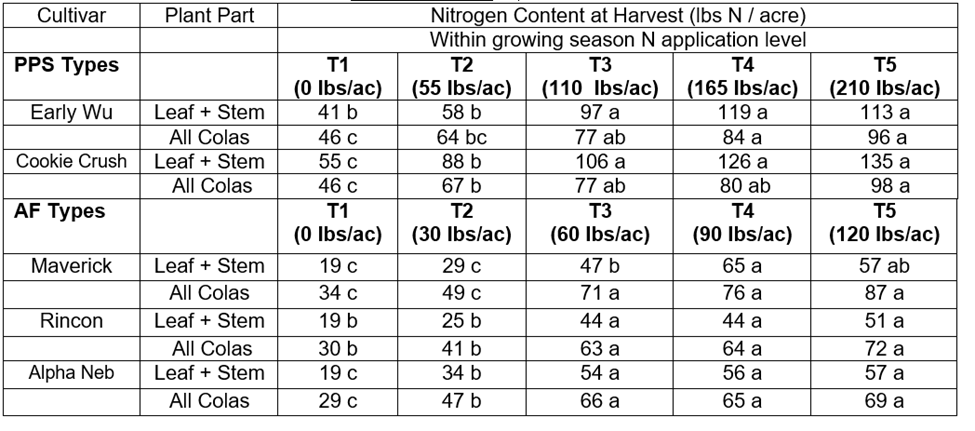
Increases in cola N content (lbs N/ac) with increasing N rates at WSREC site in AF and PPS cultivars reflected both increases in cola dry weights through T3/T4 levels and increases in cola N content (%) with increasing N rates. In both PPS and AF cultivars at the WSREC site shown in Table 6, leaf+stem and cola N content increased significantly through the T3 N application rate.
Table 6. Average nitrogen content at harvest of partitioned plant parts (Leaf + Stem, all Colas) in lbs N/acre as a function of applied nitrogen treatments for AF and PPS cultivars. Mean separation analyses were done by site and cultivar type. Different letters indicate differences at the 5% probability level.
Project Impacts
This project provides improved information on the N fertilizer needs and yield responses of a wide range of different types/growth habits of industrial hemp for California growers. The findings can assist growers and consultants in choosing an adequate N fertilizer regime when growing industrial hemp in the hot inland valleys of California. This blog post presents only a selection of this project’s findings. To receive the complete final report for this project contact FREP at FREP@cdfa.ca.gov