


Note: This is part of a Research and Outreach Update series that highlights projects funded by the California Department of Food and Agriculture’s (CDFA) Fertilizer Research and Education Program (FREP) annual grant program.
Project Title
Determination of Crop Nitrogen Removal Coefficient Values for the Imperial and Coachella Valley Cropping Systems
Project Leader
Ali Montazar, University of California Cooperative Extension (UCCE) Irrigation and Water Management Advisor, Imperial County
Project Cooperators
Daniel Geisseler, Cooperative Extension Specialist in Nutrient Management
Richard Smith, UCCE Vegetable Crops and Weed Science Advisor (Emeritus), Monterey County
Project Status
Second year
Project Location
Imperialand Riverside Counties
Overview
This project is developing region-specific nitrogen (N) uptake and N removal coefficients (also known as crop conversion coefficients) for over 15 major agricultural commodities and products grown in the Imperial, Coachella, and Palo Verde Valleys. Together, these commodities represent more than 70% of region’s crop acreage and are subject to the Irrigated Lands Regulatory Program (ILRP).
FREP staff routinely visit funded projects during grant implementation to meet with project leaders, view research trials, visit outreach events, and assess grant progress. In April 2026, FREP scientists attended the University of California (UC) Imperial 2026 Agronomic Crops and Irrigation Water Management Workshop and toured the area with Principal Investigator (PI) Ali Montazar, who gave staff an update on the progress and preliminary findings from his ongoing FREP project to develop N removal coefficients for common crops grown in southern deserts of California.
Background
As specified in the ILRP, Regional Water Boards throughout the state have implemented Irrigation and Nitrogen Management Plan (INMP) reporting requirements to gather information on grower management practices, including N budgeting and irrigation scheduling. The intention of collecting this data is to better estimate the amount of N remaining in the field that is at risk of leaching to groundwater. This includes accounting for N applied (A) through different types of fertilizers, crop amendments, and irrigation water, as well as N removed (R) through crop harvest and incorporation into woody biomass.
A key component of the equation is the crop’s N removal coefficient, which represents the N content of the harvested crop material expressed on a fresh-weight basis. However, direct measurement of N removal at harvest adds a considerable cost and regulatory burden for growers. N removal coefficients, which are developed through extensive sampling of harvested material in commercial fields, provide an alternative method for estimating the total amount of N removed while avoiding the need for growers to measure it directly through on-farm sampling and processing.
FREP funded three projects supporting the development of N removal coefficients that cover 99% (70 commodities) and 95% (75 commodities) of irrigated acres for the Central Valley and Central Coast, respectively. These have been published and shared with the coalitions and regional Water Boards in both regions and represent a comprehensive assessment of crop N removal for California cropping systems.
Research has shown that climate, soil type and condition, N availability, irrigation management, and other cultural practices can influence crop N removal. Through field trials of carrots grown in the desert region, Dr. Montazar observed N removal coefficient values that were approximately seven percentage points higher than values reported for Central Valley carrots. While preliminary, a similar trend was also observed in lettuce N removal coefficient values compared to those measured for the same crop grown on the Central Coast. This research addresses an important knowledge gap by providing accurate crop N removal coefficients that will ensure growers can accurately report their N use in compliance with ILRP requirements and supports the development of nutrient management guidance tailored to desert agriculture.
Accomplishments
- Field sampling, sample processing, and laboratory analysis were conducted for alfalfa hay, alfalfa seed, bermudagrass hay, kleingrass hay, date palm, cotton, lemon, dehydrator onions, broccoli, bell peppers, cauliflower, romaine lettuce, head lettuce, green leaf lettuce, and wheat across 144 commercial fields.
- Seven outreach events were conducted, including four grower-focused meetings and three coalition board meetings. These events were attended by over 200 participants, including growers, landowners, and coalition staff.
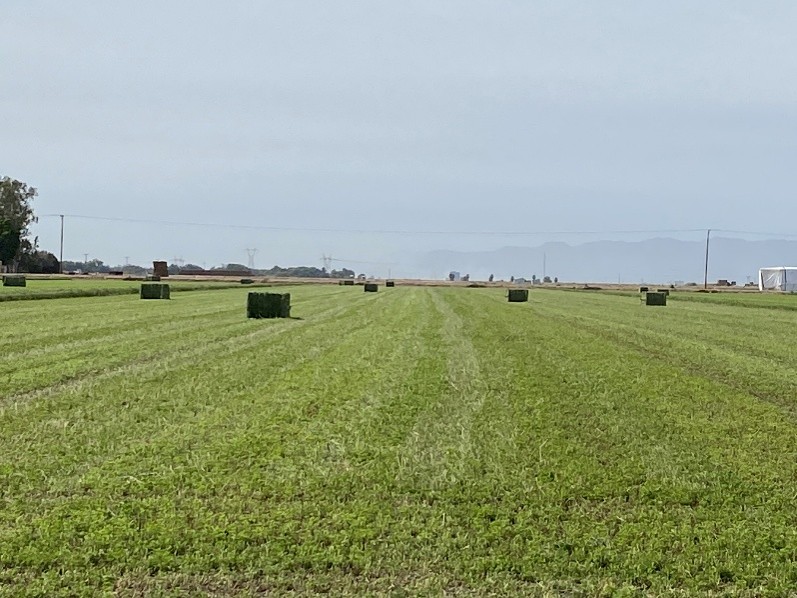
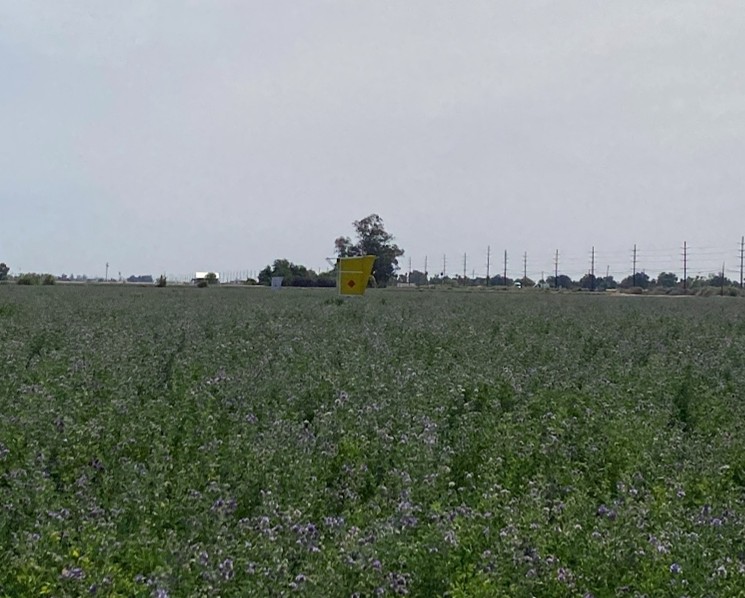
FREP staff visited fields where crops were being sampled for the N removal coefficient project. Left: Hay field that had recently been cut and baled. Typical hay crops in the region included alfalfa, bermuda grass, sudan grass, and kleingrass. Right: Field where alfalfa is being cultivated for seed. Note the yellow stand in the middle of the field used to store bee hives to ensure high pollination rates.
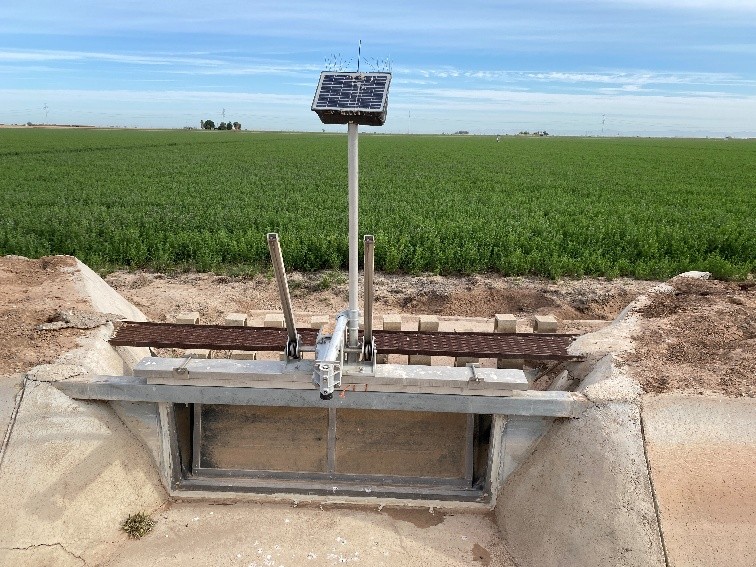
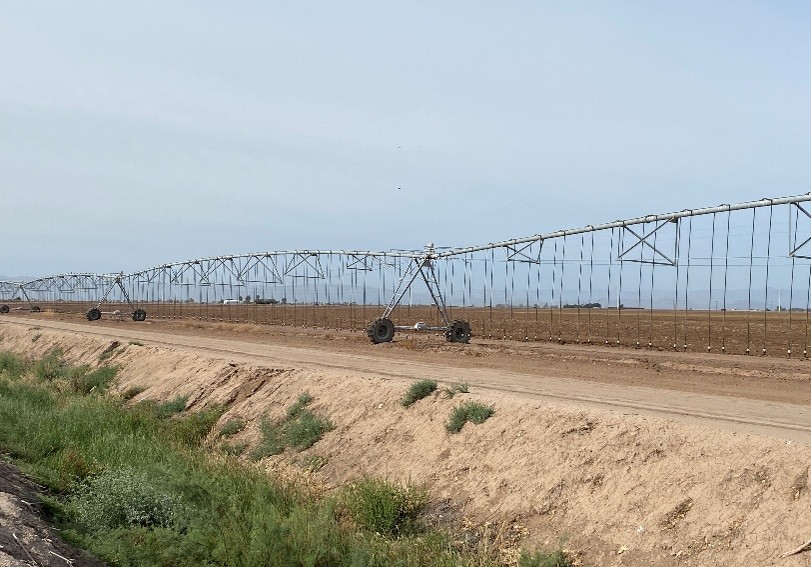
FREP staff observed various systems used to irrigate field, forage, and vegetable crops. Left: Field with an automated system that allows the irrigator to remotely open and close gates when flood irrigating. Right: While not common in the region, staff also observed overhead linear move irrigation that was being used to irrigate desert crops.
Project Evolution and Early Findings
- Based on input from Irrigated Lands Coalition boards in the Coachella and Palo Verde Valleys, the project scope was expanded to include table grapes, wheat (both straw and seed), cotton, and fresh onions, as well as alfalfa, bermuda grass, and kleingrass for seed.
- Preliminary results indicate that crop N removal coefficients in desert agricultural systems are strongly influenced by harvested biomass composition, dry matter content, and tissue N concentration rather than by crop type alone. The wide ranges observed within individual commodities, particularly alfalfa, kleingrass, broccoli, and lettuce, highlight the importance of field-specific factors such as harvest timing, cutting frequency, cultivar, and management practices.
- For forage crops, repeated harvests and regrowth cycles contributed to substantial variability in both biomass production and tissue N concentration, emphasizing the need for region- and system-specific coefficients rather than reliance on generalized statewide values.
- Results from the first year of sampling and analysis show higher N removal coefficients for most of the crops grown in the desert compared to those measured for the Central Coast and Central Valley. While these results are preliminary, continued sampling and measurement in the second and third years of the project will provide a robust set of data that can be used to better understand regional crop N removal differences.
To learn more about this project and other current and completed FREP projects, please visit: https://www.cdfa.ca.gov/is/ffldrs/frep/Research.html.